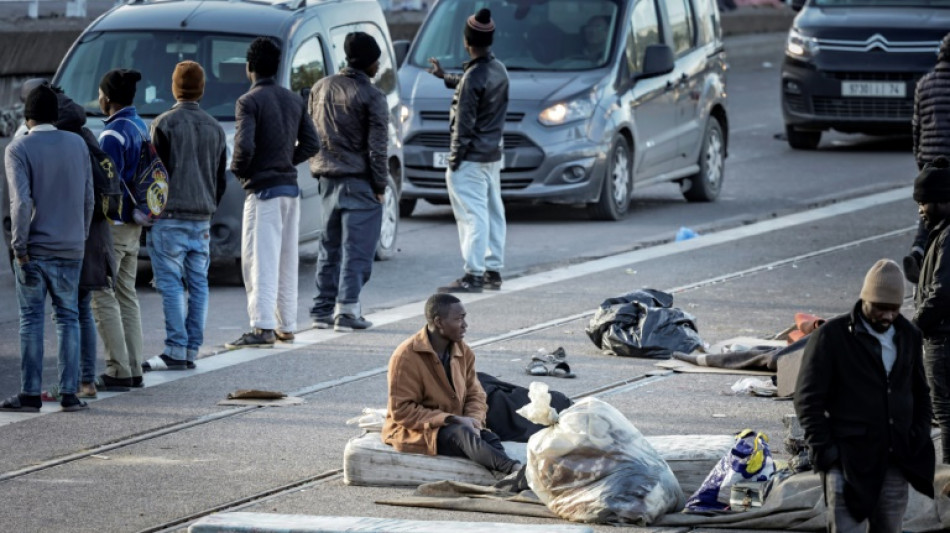
Migrants in Morocco limbo as they cling to Europe dreams / Photo: FADEL SENNA - AFP

 UK PM calls for 'honest discussion' about EU free movement

 Far-right leader Le Pen kicks off tilt at French presidency amid nationwide protests

 Naomi Osaka could quit tennis if daughter asks her to

 Last MotoGP race at Phillip Island cancelled due to weather in Marquez setback

 Sri Lanka seeks faster green energy shift after oil shocks
 Riyadh airport resumes flights following Houthi attacks

 'Call of Duty' North Korea invasion edition tops sales charts in South
 Musk accuses Ukraine of violating Starlink's terms of service
 Fed expected to hold rates steady days ahead of US midterms

 More Lula, or back to the Bolsonaros? Brazil votes in cliffhanger
 Jorge Martin out of Australian MotoGP with fracture: team

 Antonelli storms to US Grand Prix pole on weekend he can take title

 Apologetic Alvarez fires Atletico to win against Deportivo

 Lens beat PFC in Ligue 1 matchday impacted by social unrest

 Valkyries hit back against Dream to level WNBA Finals

 'Fighting for our rights': Paris protesters determined to march on
 Clashes break out in Paris, other French cities amid fresh protests

 Spurs seal rare win at Chelsea as Palmer sees red

 Nearly 1,000 arrested in French protests marred by 'elevated' violence: minister

 France extends detention of suspected racist shooter

 Andrade and Nemour star as Biles cheers at world gymnastics champs
 Nigeria's Tinubu defends record as economy bites ahead of election
 'Guiding star' Fuellkrug bags Bremen brace, Leipzig win
 Man City's perfect start ended by Aston Villa, Arsenal go joint-top

 Arsenal sink Everton to join Man City at Premier League summit
Oumar left home in Guinea five years ago in search of a better life in Europe, but today he inhabits a daily purgatory of hunger, cold and police violence in Morocco.
"Just surviving every day is a battle," said the 25-year-old.
"It's exhausting not eating enough, not sleeping under a roof, not feeling safe, experiencing racism."
He spends his nights camped out on the pavement outside a Casablanca bus station, the makeshift home of hundreds of sub-Saharan Africans whose dreams of reaching Europe are on hold in Morocco.
"We get chased away early in the morning by the police. Then we wander around and come back to the same place at the end of the day," said Oumar.
Like the other migrants interviewed in this report, Oumar's name has been changed.
He has tried several times to reach Spanish territory from Morocco but has so far been unsuccessful.
Oumar sits killing time opposite the Oulad Ziane bus station with a few dozen, mostly Guinean migrants.
Some cook in a makeshift kitchen while others lie exhausted on the pavement.
Someone has hung clothes and blankets on a nearby wall to dry.
Bakary, also from Guinea, said he had been living here for three years.
"This is our sad reality but nobody wants to see it," the 18-year-old said.
The migrants set up this makeshift camp on the edge of the coastal port city of 4.2 million people because of its proximity to the bus station, a major transport hub.
Today, the down-at-heel neighbourhood sees repeated flare-ups with the authorities.
This month, six migrants were arrested following clashes during a police operation to evict people camping on the site of a tramway extension.
Today, they're back on the same site, divided into groups by country of origin with everyone pitching in to survive.
"Wherever we set up camp, they chase us away," said Boubacar, 27, from Mali. "It's not as if we want to sleep on the tram tracks, but they don't offer us any alternative."
- 'Europe or death' -
Most residents were reluctant to speak to a journalist, but one Moroccan sweets vendor said the migrants were "part of the landscape now, they don't bother anyone".
The station toilets are the only place the migrants have to wash.
"Sometimes they let us in, sometimes no," said Boubacar, accusing residents of the neighbourhood of racism.
Catholic charity Caritas provides migrants with basic medicines and healthcare.
The Moroccan press regularly voices opposition to the migrants.
"End clandestine immigration!" said a recent headline in weekly newspaper Maroc Hebdo, calling it "a social, security and political problem that the state is struggling to manage".
Noureddine Riadi of Morocco's main human rights group, the AMDH, said the migrants were facing "difficult conditions" and called on authorities to do more to help.
"The most vulnerable should be housed in temporary residential centres," he said.
Lamine, a 20-year-old who has tried five times to penetrate the heavily secured Spanish enclave of Melilla on Morocco's northern coast, said he has almost given up.
"We're struggling to keep believing, but my optimism is fading every day," he said.
Morocco has taken periodic steps to regularise the status of migrants on its territory, many of whom arrive via the country's desert border with Algeria, which is officially closed.
But it is under growing European pressure to strengthen border controls and restrict the movement of migrants within its territory.
Spanish newspaper El Pais has reported that the EU is considering a 500 million euro grant for Rabat to tackle clandestine migration.
In 2022, Moroccan police detained more than 32,000 migrants and arrested 566 people suspected of involvement in people trafficking, according to official figures.
But migrants in Casablanca say they are not giving up on the dream of reaching Europe.
Bakary said going home would mean "admitting defeat".
"For me, it's Europe or death," he said.
H.Jarrar--SF-PST