Millions of Thais banish the booze for Buddhist Lent / Photo: Lillian SUWANRUMPHA - AFP

 Indonesian court hears 'negligence' complaint against state over fires, haze

 Rubio in Greece to urge against Western civilisation 'decline'

 Micron workers at Taiwan plant vote in favour of strike

 In 'The Social Reckoning,' Jeremy Allen White takes on Facebook's 'frightening' ambition

 Chip industry activists call for South Korea to recognise cancer cases
 Famine-scarred southern Madagascar braces for El Nino
 How the EU regulates lobbyists
 I.Coast refuge offers lifelong care for youngsters scorned as 'sorcerers'

 Indian central bank hikes rates for first time in more than 3 years

 Hotel Blacklist Launches New Accommodation Industry Risk Assessment Tool

 Bangladesh nuclear plant draws hope -- and worry

 US beat Canada 1-0 to wrap up four-win international break

 Turkey, Australia's joint COP31 leadership raises doubts

 For Turkish NGOs, COP31 offers rare space for action

 Sleep, appetite, gene-editing experts contend for Nobel chemistry prize

 Nobel Peace Prize haunted by the 'spectre' of Trump

 Africa launches own credit agency in bid for cheaper borrowing

 US, China, EU: three paths to regulating AI

 Australia's High Court rules against coal mine in landmark climate case

 Australia touts new funds for Pacific infrastructure at Fiji 'pre-COP'

 Eva Marie Saint, Oscar winner of Hollywood classics, dies at 102

 Australia probes app used in cheap smart glasses over privacy fears

 England needed to 'move on' from World Cup pain, says Tuchel

 O'Neill to stay at Celtic after period of "reflection"

 Kane marks 125th England cap with Wembley Nations League double

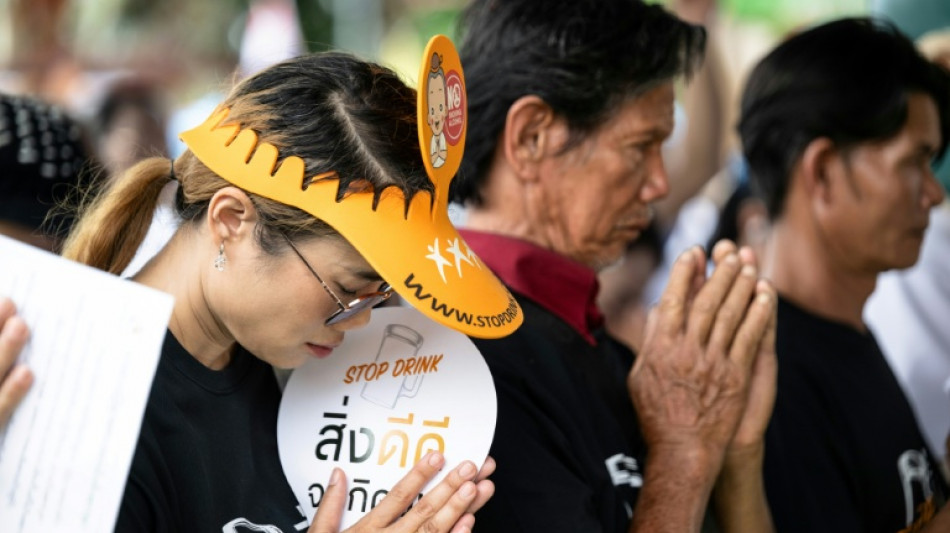
With her palms pressed together and her head bowed, Wassana Nak-umma vowed to give up alcohol for three months, joining millions of Thais in an abstinence campaign blending public health with spirituality.
The 42-year-old housewife, who took the pledge at a Buddhist temple in Samut Sakhon, west of Bangkok, admitted she used to be a "heavy drinker".
"I used to get so drunk that my kids had to clean up my vomit," she told AFP candidly.
But a concerned relative persuaded her to join a campaign to give up alcohol during Khao Phansa, a three-month period of reflection observed by Buddhists akin to Christian Lent.
"I still craved it. Whenever I saw people buying liquor or beer at stores, I would look at them and want to drink like them," she said.
"But I held back, telling myself it was only three months. After that three-month period, I realised, 'Hey, I can do this! Next year, I must do it again'."
That was in 2024. Wassana went back to drinking, but in moderation, and this week joined hundreds in Samut Sakhon to pledge abstinence for her third year.
Avoiding drugs and alcohol is a key precept of Buddhism.
But Thailand, where more than 90 percent of the population identify as Buddhist, has the third highest per capita consumption of alcohol in Asia, according to 2024 data from the World Health Organization (WHO).
It was to address this paradox that the so-called Buddhist Lent campaign began in 2003, and last year it claimed more than eight million adherents.
- Spiritual anchor -
The start of Khao Phansa on Thursday was a joyous affair in the rural province of Samut Sakhon, featuring offerings to monks and traditional dances.
Dozens of people also paraded through the village on "salengs" -- scooters with sidecars used locally to transport coconuts -- brandishing placards featuring images of healthy, smiling livers.
Phayom Raksa solemnly recited a pledge that touched on the teachings of the Buddha, and mentioned Thailand's king and the well-being of the nation.
The 66-year-old former coconut farmer stopped drinking entirely after participating in the campaign for the first time six years ago.
"My kids were ashamed of me -- their dad got drunk every day and didn't care about them," he told AFP, saying that he also spent all his money on alcohol.
But he now urged others to follow his example, saying: "I'd like everyone to try doing what I did -- to think and look at positive things."
Abstinence campaigns have gathered ground in many countries in recent years, notably the trend to pursue a "Dry January" after Christmas and New Year's Eve excesses.
They are often linked to an increased focus on healthy behaviour.
But Ubolwan Kongsawang, a regional volunteer with Thialand's Stop Drinking Network, said the Buddhist Lent campaign provides a "spiritual anchor" that boosts motivation.
"When individuals take a pledge before a Buddha image, at a temple, or within their community, they feel bound to honour their word," she said.
- 'Beyond Lent' -
Organisers of the campaign have revamped their messaging this year, emphasising how giving up or even cutting down alcohol consumption can result in improved health, better relationships -- and crucially, save money.
"Our goal is not necessarily total abstinence for everyone," said Dr. Pongthep Wongwatcharapaiboon, director of the Thai Health Promotion Foundation, a government agency.
"Many reduce their consumption and discover the health benefits, which is already a success."
Thailand in December relaxed decades-old restrictions on selling alcohol in the afternoon, which were originally intended to stop government employees drinking on the job.
But it remains banned on religious public holidays and around elections.
One advertisement for the Buddhist Lent campaign focuses on the social pressure to drink, in a culture where alcohol is everywhere, from funerals to festivals.
"We are trying to transform the drinking culture itself, not just reduce individual consumption," says Teera Wacharaprannee, head of the Stop Drinking Network.
"Our strategy is to continue beyond Lent, supporting villages and communities to reduce alcohol in daily life."
I.Matar--SF-PST