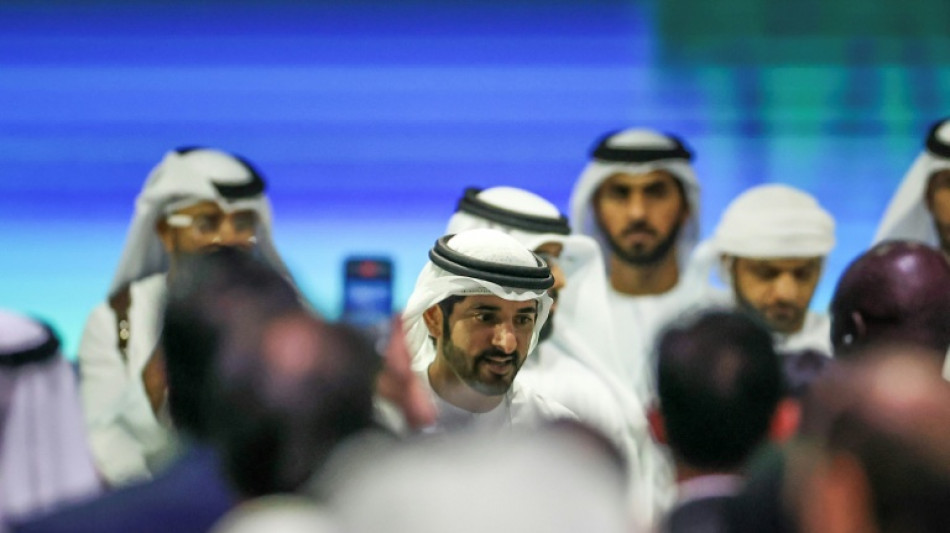
AI romance scam impersonating Dubai prince ensnares victims / Photo: FADEL SENNA - AFP

 Gauff says online abuse was 'draining' after China Open exit

 As sector struggles, Porsche puts luxury ahead of volume
 'It's personal': Fiji minister pushes better climate finance at pre-COP

 Russia glosses over dark Soviet past in reinvented museum

 UK tax body opened probe into Man City in 2018: FT
 Yemen's Houthis claim new attacks on Saudi airports as conflict deepens
 Germany factory production at highest level for 18 months

 Thailand floods death toll rises to 60 since mid-September

 US pushes Russia for information on plague reports

 Myanmar leader lands in Malaysia for migrant return talks

 Indian central bank hikes rates for first time since 2023

 US military on Okinawa face curfew, alcohol ban after murder case

 Fierce lobbying in EU over 'forever chemicals'

 Dodgers beat Braves and Padres avoid sweep in MLB playoffs
 Mourning, war and elections as Israel marks October 7

 Messi says Argentina retirement is 'saddest day of my career'

 Oil rises and stocks fall as Hormuz worries flare

 Pacific presses world for help 'surviving' climate change at pre-COP summit

 Verstappen revival to be put to the test in steamy Singapore
 US woman who survived botched execution is conscious, speaking: lawyers

 Climate champion Australia digging more coal
 Emotion, tears as Messi retires from Argentina national team

 Dodgers push Braves to the brink of MLB playoff exit

 Crisis-stricken Haiti postpones elections

 N. Korea's Kim pledges 'invariable support' in Putin birthday letter
Maria believed she was romancing a prince from Dubai, captivated by his flirtatious smile and declarations of affection he showered on her during live video calls. But the suitor was an AI deepfake, making her yet another victim of an online romance scam.
The case illustrates how fraudsters posing as the real-life crown prince of Dubai ensnare victims by cultivating online relationships before swindling them out of money, with researchers tracing some of the scams to crime syndicates in Nigeria.
Maria met the scammer impersonating Prince Hamdan bin Mohammed, also known by his pen name Fazza, on a dating site before the conversation moved to a messaging app where he bombarded her with romantic messages.
"He kept on messaging me even when I was sleeping," the Filipino domestic worker told AFP, requesting that her real name and age be withheld.
"It felt like there was a love spell that connected our minds."
In one recording of a WhatsApp video call seen by AFP, the scammer, appearing lifelike as the prince, flickered on the screen. His words matched his lip movements, but not the prince's voice.
"Hello beloved," the voice told Maria. "I really appreciate your love and support."
Maria, who was initially too lovelorn to suspect fraud, lost a year's worth of savings.
The scammer manipulated her into paying 100,000 pesos ($1,625) for what he claimed were a marriage certificate and a "royal membership card," which he said would help her secure a job in Dubai.
Her suspicion arose when he proposed meeting her at a hotel and demanded another 60,000 pesos ($974) for the booking. When she scrutinized his Facebook page, which has since been taken down, she noticed the account was based in Nigeria.
She cut off communication, sending one final message: "Go to hell, scammer."
"Many people told me it's good I didn't go crazy after this experience," Maria said.
- Blowing-kiss emojis -
The fraud is part of a broader ecosystem of what have become known as "fake Dubai prince" scams targeting both hearts and wallets.
Scammers exploit the Emirati royal's likeness by drawing on his vast online presence, including his more than 17 million Instagram followers, and sometimes even copying the prince's authentic poems to deceive victims.
AFP identified multiple Facebook groups impersonating the royal, some with thousands of followers, inviting users to WhatsApp or Telegram chats with the "prince."
The groups post manipulated but lifelike images, including one depicting the prince on one knee and holding a ring, and another showing him offering a red rose alongside the caption: "Sweetheart can I get a 'love you' on WhatsApp?"
While some users warned in the comments that the posts are scams, many others responded with hearts and blowing-kiss emojis.
As the fraud spreads, awareness groups have sprung up to alert users, including one on Instagram called "Do not fall for fake prince."
A change.org petition titled "Stop Fazza Scam" called on Sheikh Hamdan's staff to raise awareness against scammers impersonating the royal using Dubai phone numbers and "requesting large sums of money, either as donations or marriage certificates, all of which are forged."
"Significant payments are requested in banks in countries other than those of victims, sometimes even in crypto currencies, making it harder to trace," the petition said.
- 'Technology is improving' -
Dubai authorities did not respond to AFP's request for comment.
He is far from the only public figure whose identity has been exploited by scammers. Last year, French authorities launched a probe to identify fraudsters posing as Brad Pitt who scammed a woman out of 830,000 euros ($945,000).
The Global Anti-Scam Alliance estimates that consumers worldwide lost $442 billion to scams, including romance fraud, last year.
It was unclear which AI tools were used to generate the real-time video chats with Maria.
The internet is awash with AI-powered face-swapping technology and a new generation of motion-control tools capable of producing highly realistic videos, allowing users to precisely manipulate a person's movements and facial expressions in real time.
'The technology is improving rapidly, and it is likely that soon real-time video deepfakes will become better and better," Cornell University's David Rand told AFP.
"Once this happens, it becomes fundamentally impossible to tell whether any not-in-person conversation is real."
burs-ac/msp
K.AbuDahab--SF-PST