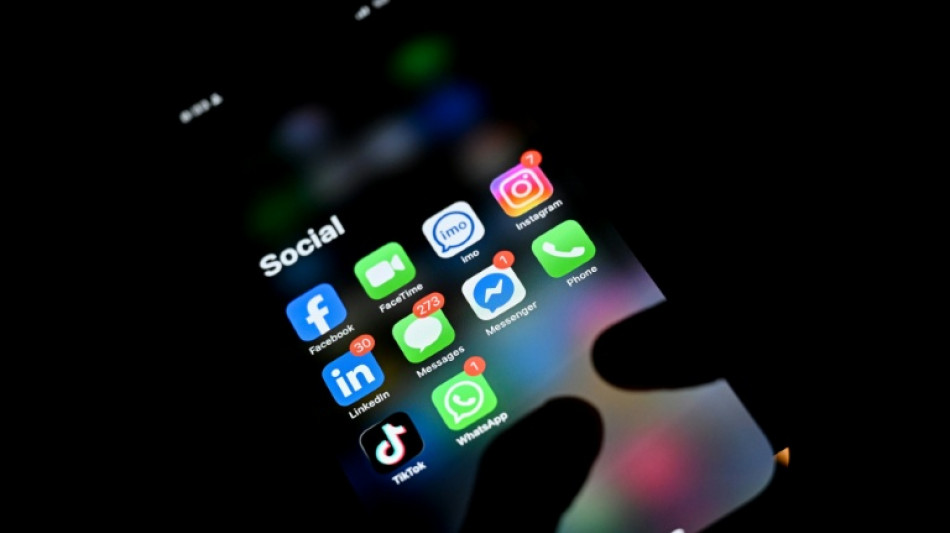
Australia teen social media ban has little impact: research / Photo: Ishara S. KODIKARA - AFP

 Gauff says online abuse was 'draining' after China Open exit

 As sector struggles, Porsche puts luxury ahead of volume

 'It's personal': Fiji minister pushes better climate finance at pre-COP

 Russia glosses over dark Soviet past in reinvented museum

 UK tax body opened probe into Man City in 2018: FT

 Yemen's Houthis claim new attacks on Saudi airports as conflict deepens
 Germany factory production at highest level for 18 months

 Thailand floods death toll rises to 60 since mid-September

 US pushes Russia for information on plague reports
 Myanmar leader lands in Malaysia for migrant return talks

 Indian central bank hikes rates for first time since 2023

 US military on Okinawa face curfew, alcohol ban after murder case

 Fierce lobbying in EU over 'forever chemicals'

 Dodgers beat Braves and Padres avoid sweep in MLB playoffs
 Mourning, war and elections as Israel marks October 7

 Messi says Argentina retirement is 'saddest day of my career'

 Oil rises and stocks fall as Hormuz worries flare

 Pacific presses world for help 'surviving' climate change at pre-COP summit

 Verstappen revival to be put to the test in steamy Singapore

 US woman who survived botched execution is conscious, speaking: lawyers

 Climate champion Australia digging more coal
 Emotion, tears as Messi retires from Argentina national team

 Dodgers push Braves to the brink of MLB playoff exit

 Crisis-stricken Haiti postpones elections
 N. Korea's Kim pledges 'invariable support' in Putin birthday letter

Australia's social media ban for under 16s has had little impact on teenagers' scrolling habits, researchers said Thursday in one of the first evaluations of the world-leading measures.
Australia in December banned under 16s from the likes of Facebook, Instagram and TikTok, in a crackdown designed to protect children from online bullying and "predatory algorithms".
But there is little evidence to suggest teenagers have turned away from social media as a consequence, a team of Australia-based researchers found in a peer-reviewed study published by the British Medical Journal.
Underage users have been dodging the restrictions by using accounts registered to older people, setting up fake accounts, or by logging into private browsers.
"We found insufficient evidence to conclude that exposure to the Act had any early substantial effects on social media use among adolescents aged under 16," the researchers wrote.
There is strong global interest in whether Australia's laws could provide a blueprint for how to rein in increasingly powerful tech giants.
A growing mass of nations have either introduced or are mulling similar bans -- including the United Kingdom, Indonesia, the UAE and New Zealand.
The researchers surveyed more than 400 young social media users immediately before the restrictions came into effect, and again three months after.
There was little change for users aged 12-13, a slight decrease for the 14-15 age group, and an increase in use for those aged 16 and older.
"The findings suggest that the period immediately after the introduction of the act was characterised by limited implementation, incomplete compliance, and substantial circumvention of social media restrictions."
- Not 'impossible' -
Tech companies face fines of up to Aus$49.5 million ($34 million) if they fail to show meaningful efforts to weed out underage users.
Australia in March accused Facebook, TikTok and YouTube of failing to meet their obligations.
"Australia's world-leading social media laws are not failing. But big tech is failing to obey the laws," Communications Minister Anika Wells said at the time.
"None of this is impossible. None of this is even difficult for big tech, who are innovative billion-dollar companies."
The nation's eSafety Commission separately flagged "significant concerns" about Facebook, Instagram, Snapchat, TikTok and YouTube.
A growing body of research suggests too much time online is taking a toll on teen well-being, and Australia's ban has been hailed as a godsend for parents sick of seeing children glued to their phones.
Although platforms have pledged to abide by the laws, they have warned the measures could instead push teenagers into dark, unregulated corners of the internet.
Social media companies bear the sole responsibility for checking that Australia-based users are 16 or older, and must prove they have taken "reasonable steps" to weed out young teenagers.
Some platforms are using AI tools to estimate ages based on photos, while users can also choose to prove their age by uploading a government ID.
X.AbuJaber--SF-PST