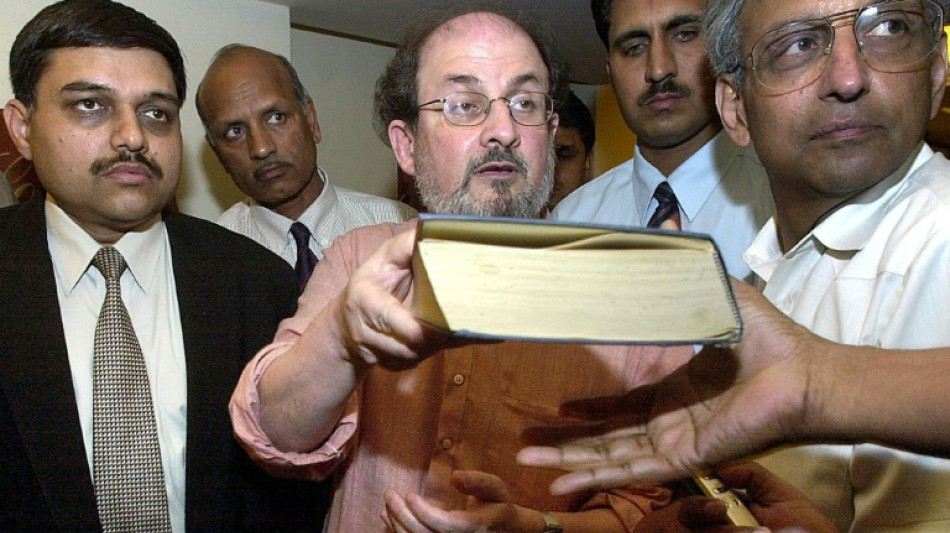
February 14, 1989: The fatwa against Salman Rushdie / Photo: John MACDOUGALL - AFP/File

 Seeing pivotal election, Israelis fly from around world to vote
 South Korea's Eom 'racially abused' in England's Championship: club
 Asian markets mixed as tech firms claw back some losses
 India shuts down iconic Delhi protest site after three decades
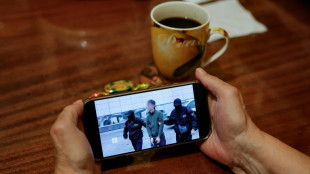 Japan urges Russia for 'impartial treatment' of arrested journalist
 Lula, Bolsonaro ordered to call off attempts at online censorship
 EU takes a page from Ireland's AI playbook
 Global deforestation slowed in 2025 but surged in Congo basin: study

 Saudi says Houthi attacks sparked Aramco fire, wounded 4 in Riyadh
 Few buyers for starving cattle in El Nino parched El Salvador

 Bybit Expands Beyond Crypto as CEO Outlines Next Phase of Financial Platform

 Bayern held by Viking after 'super dumb' Olise red in Champions League
 Why AI makes computer worms harder to stop

 US fines Bank of America $1.2 bn for anti-money laundering violations
 Bayern held by Viking after Olise sees red in Champions League

 Atletico down Carrick's struggling Man United
 Croatia trials full driverless robotaxi service
 US stocks dip ahead of inflation data as tech sell-off hits Asia

 No lights, no friends: Cuban youth grapple with loneliness
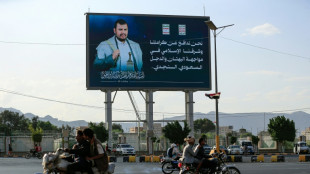 Saudi coalition strikes Yemen oil sites after Houthi attacks
 French economy minister denies country caught in debt 'snowball'
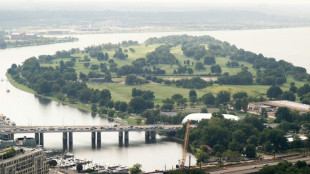 Judge extends halt to Trump's golf course tree-cutting
 Milan's Saelemaekers set for lenghty spell out after ankle surgery

 Nvidia says to invest in French medical website
 Real Madrid's Mourinho has 'trust' in referees despite complaints

Friday's knife attack on Salman Rushdie comes more than 33 years after the fatwa against him by Iran's supreme leader Ayatollah Ruhollah Khomeini, in which he sentenced him to death.
- The Fatwa -
On February 14, 1989 Khomeini called for him to be killed for writing "The Satanic Verses", which the cleric said insulted Islam.
In a fatwa, or religious decree, Khomeini urged "Muslims of the world rapidly to execute the author and the publishers of the book" so that "no one will any longer dare to offend the sacred values of Islam."
Khomeini, who was 89 and had just four months to live, added that anyone who was killed trying to carry out the death sentence should be considered a "martyr" who would go to paradise.
A $2.8-million bounty was put on the writer's head.
The British government immediately granted police protection to Rushdie, an atheist born in India to non-practising Muslims.
For almost 13 years he moved between safe houses under the pseudonym of Joseph Anton, changing base 56 times in the first six months. His solitude was worsened by the split with his wife American novelist Marianne Wiggins, to whom "The Satanic Verses" are dedicated.
"I am gagged and imprisoned," he recalled writing in his diary in his 2012 memoir, "Joseph Anton".
"I can't even speak. I want to kick a football in a park with my son. Ordinary, banal life: my impossible dream."
- 'Blasphemous' -
Viking Penguin published "The Satanic Verses" in September 1988 to critical acclaim.
The book is set by turns in the London of Conservative British prime minister Margaret Thatcher and ancient Mecca, Islam's holiest site.
It centres on the adventures of two Indian actors, Gibreel and Saladin, whose hijacked plane explodes over the English Channel.
They re-emerge on an English beach and mix with immigrants in London, the story unfolding in surreal sequences reflecting Rushdie's magic realism style.
The book was deemed blasphemous and sacrilegious by many Muslims including over references to verses alleged by some scholars to have been an early version of the Koran and later removed.
These verses allow for prayers to be made to three pagan goddesses, contrary to Islam's strict belief that there is only one God.
Controversially, Rushdie writes of the involvement of a prophet resembling the founder of Islam, Mohammed.
This prophet is tricked into striking a deal with Satan in which he exchanges some of his monotheistic dogmatism in favour of the three goddesses. He then realises his error.
Khomeini and others insist he had depicted the prophet irreverently.
- 'Hang Rushdie' -
In October 1988, Indian Prime Minister Rajiv Gandhi banned the import of the book, hoping to win Muslim support ahead of elections. Some 20 countries went on to outlaw it.
In January 1989, Muslims in Britain's northern city of Bradford burned copies in public.
A month later, thousands of Pakistanis attacked the US Information Center in Islamabad, shouting "American dogs" and "hang Salman Rushdie". Police opened fire, killing five.
Khomeini's fatwa provoked horror around the Western world.
There were protests in Europe, and London and Tehran broke off diplomatic relations for nearly two years.
In the United States, authors like Susan Sontag and Tom Wolfe organised public lectures to support Rushdie.
The author tried to explain himself in 1990 in an essay titled "In Good Faith" but many Muslims were not placated.
- Attacks -
Rushdie gradually emerged from his underground life in 1991, but his Japanese translator was killed in July that year.
His Italian translator was stabbed a few days later and a Norwegian publisher shot two years later, although it was never clear the attacks were in response to Khomeini's call.
In 1993, Islamist protesters torched a hotel in Sivas in central Turkey, some of whom were angered by the presence of writer Aziz Nesin, who sought to translate the novel into Turkish. He escaped but 37 people were killed.
In 1998, the government of Iran's reformist president Mohammad Khatami assured Britain that Iran would not implement the fatwa.
But Khomeini's successor, Ayatollah Ali Khamenei, said in 2005 he still believed Rushdie was an apostate whose killing would be authorised by Islam.
- 'Islamophobia' -
Many Muslims were furious when Rushdie was knighted by Queen Elizabeth II in 2007 for his services to literature.
Iran accused Britain of "Islamophobia", saying its fatwa still stood, and there were widespread Muslim protests, notably in Pakistan.
Rushdie was by then living relatively openly in New York where he moved in the late 1990s, and where his recent novels are set.
After many years living in the shadows, he became something of a socialite and is seen by many in the West as a free speech hero.
Until Friday's knife attack, he had very much resumed a normal life.
B.Mahmoud--SF-PST