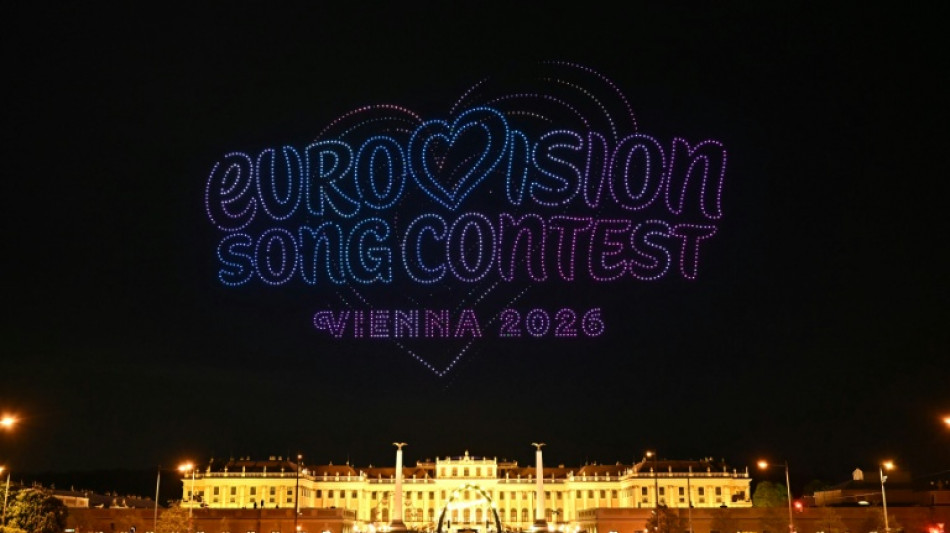
Eurovision: how it works / Photo: Joe Klamar - AFP

 West must embrace 'national power' or face decline: Rubio
 Shell refining margins reach record highs as wars hit supply
 Former Spain, Barca winger Pedro retires from football
 Arteta signs new Arsenal deal until 2030
 Stocks decline as oil climbs on Mideast flareup
 Gauff says online abuse was 'draining' after China Open exit
 As sector struggles, Porsche puts luxury ahead of volume
 'It's personal': Fiji minister pushes better climate finance at pre-COP
 Russia glosses over dark Soviet past in reinvented museum
 UK tax body opened probe into Man City in 2018: FT
 Yemen's Houthis claim new attacks on Saudi airports as conflict deepens
 Germany factory production at highest level for 18 months
 Thailand floods death toll rises to 60 since mid-September

 US pushes Russia for information on plague reports
 Myanmar leader lands in Malaysia for migrant return talks
 Indian central bank hikes rates for first time since 2023
 US military on Okinawa face curfew, alcohol ban after murder case
 Fierce lobbying in EU over 'forever chemicals'
 Dodgers beat Braves and Padres avoid sweep in MLB playoffs
 Mourning, war and elections as Israel marks October 7
 Messi says Argentina retirement is 'saddest day of my career'
 Oil rises and stocks fall as Hormuz worries flare
 Pacific presses world for help 'surviving' climate change at pre-COP summit
 Verstappen revival to be put to the test in steamy Singapore
 US woman who survived botched execution is conscious, speaking: lawyers
The rules of the Eurovision Song Contest -- the biggest live televised music event -- have evolved to keep pace with technological, artistic and geopolitical changes over the past 70 years.
Here is a look at how the competition is put together, how artists are chosen and how the voting system works in 2026:
- Organisers -
Eurovision is an international co‑production by public broadcasting services that are members of the European Broadcasting Union (EBU), the world's biggest public service media alliance.
Held in May, the annual competition is hosted by the broadcaster of the country that won the previous edition.
Since the EBU has 113 member organisations in 56 countries, the contest is open to countries from outside the continent, and it is presented in both English and French.
- Who takes part and who doesn't? -
Each country can send one song, selected through national processes by the participating broadcasters.
This year 35 countries are taking part.
France, Germany, Italy, Spain and the United Kingdom have a guaranteed place in the final, due to their larger financial contribution, as does the host country.
But Spain has decided to boycott this year's edition, together with several other countries, in protest at Israel's participation, over its war in Gaza.
The participating countries compete, after a random draw, in two semi‑finals.
In each semi‑final, 10 of them qualify for the grand final.
- The rules -
The winner is determined by the votes of national juries appointed by the participating broadcasters and by the public vote, cast by text message or online.
Viewers are not allowed to vote for their own country, and international audiences outside the participating countries can also cast their votes online.
The song that receives the highest combined score from the public vote and the national juries is declared the winner.
The songs have to be original and must not exceed three minutes.
All performers must be at least 16 years old and a maximum of six performers may appear live on stage at the same time.
"Political statements, gestures, or actions during the event, including any instrumentalisation of the contest for political or other purposes are prohibited," the EBU says on its website.
Failure to comply with the rules may result in disqualification.
- Last 10 Eurovision winners -
2025: Austria -- JJ, "Wasted Love"
2024: Switzerland -- Nemo, "The Code"
2023: Sweden -- Loreen, "Tattoo"
2022: Ukraine -- Kalush Orchestra, "Stefania"
2021: Italy -- Maneskin, "Zitti E Buoni"
2019: Netherlands -- Duncan Laurence, "Arcade"
2018: Israel -- Netta, "TOY"
2017: Portugal -- Salvador Sobral, "Amar Pelos Dois"
2016: Ukraine -- Jamala, "1944"
2015: Sweden -- Mans Zelmerlow, "Heroes"
The contest did not take place in 2020 due to the coronavirus pandemic.
- Wins per country -
7 -- Ireland, Sweden
5 -- Britain, France, Luxembourg, Netherlands
4 -- Israel
3 -- Austria, Denmark, Norway, Italy, Switzerland, Ukraine
2 -- Germany, Spain
1 -- Azerbaijan, Belgium, Estonia, Finland, Greece, Latvia, Monaco, Portugal, Russia, Serbia, Turkey, Yugoslavia
X.Habash--SF-PST