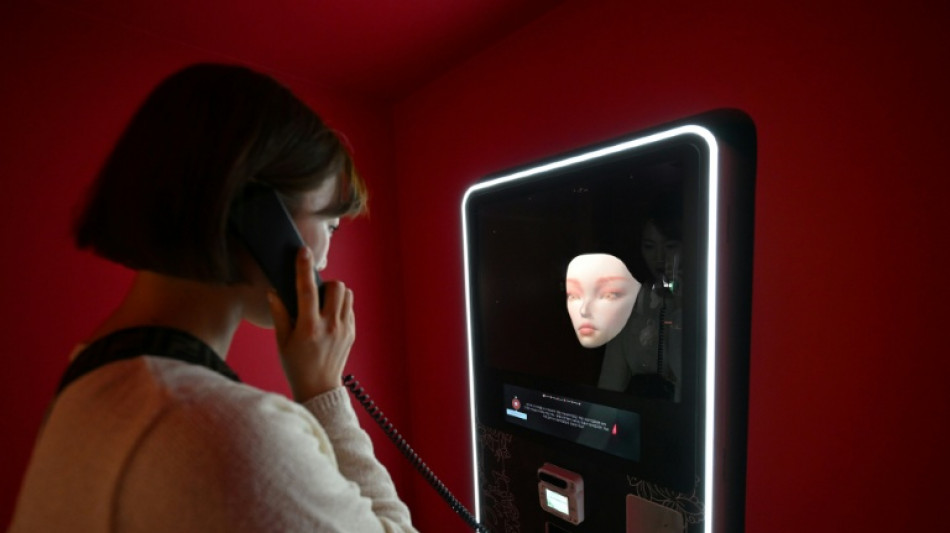
'AI shamans' tell the fortunes of curious South Koreans / Photo: Jung Yeon-je - AFP

 US woman who survived botched execution is awake and speaking

 From 1800s to modern pharma: a Nobel-winning chemistry quest
 Southampton boss Eckert given suspended ban over 'Spygate'

 Russia warns of 'false' information as second plague case reported

 IEA ready to release more oil reserves if necessary

 HSBC 'consults' over UK unit job cuts amid AI adoption

 UK court quashes five ex-traders' Libor rate rigging convictions

 XM Receives “Global Customer Experience Leader Award 2026” at the TrustFinance Performance Awards

 Stocks slide as oil climbs on Mideast flareup

 Heavy casualties in Ukraine after Russian strikes

 French wine harvest set to hit historic low

 Kyiv 'cannot agree' to EU membership limiting food exports: minister

 Arteta targets more Arsenal glory after signing new deal until 2030

 Russell hit with Singapore grid penalty for taking new power unit

 Spotify expands audiobooks to more than 180 markets

 French-Japanese duo wins chemistry Nobel for solving molecular 'mystery'

 England's Nations League surge helps heal World Cup wounds

 Mayor of opposition stronghold Izmir defects to Erdogan party

 Mertens beats Gauff to set up Swiatek clash at China Open

 Benin full of pride at role in Messi's last dance

 France suspends stun grenade use at student protests ahead of PM speech

 Indonesian court hears 'negligence' complaint against state over fires, haze

 Rubio in Greece to urge against Western civilisation 'decline'

 Micron workers at Taiwan plant vote in favour of strike

 In 'The Social Reckoning,' Jeremy Allen White takes on Facebook's 'frightening' ambition

The sound of tinkling bells drifts through an alley in central Seoul, an unmistakable sign that a shaman is near -- although in this case the mystic is a robot powered by artificial intelligence.
Many South Koreans still place great value in shamanic traditions, which purport to divine a person's future based on the day and time they were born.
Practitioners, known as "mudang", wear long, colourful robes and perform dances and chants to commune with the gods -- sometimes even walking on sharp blades to demonstrate their spiritual connection.
However, at Vinaida, a cultural products store in the capital, they are computer-generated avatars on screens.
Visitor Kim Da-ae, 36, called it a "unique experience".
A visit with a real shaman can feel "scary and burdensome", she told AFP.
"But I was just walking by and read this AI sign... So I walked in with a light heart."
Portraits of virtual shamans resembling characters from the popular animation "KPop Demon Hunters" greet passersby at Vinaida, which means "I pray earnestly" in Korean.
Inside a booth, Kim typed her name, gender and date of birth into a computer, before a shaman -- a suspended mask with the image of a human face projected onto it -- asked her to explain her concern through a headset.
The technology combines voice recognition with a generative AI chatbot so that the shaman and the customer can interact.
It then refers to a centuries-old belief system called "saju", or the "four pillars of destiny", to interpret their fate according to the year, month and day of their birth.
Customers then receive a plastic "talisman" bearing a digital QR code that they can scan with their phones to read their fortunes in detail.
Across the room, a bespectacled robot uses a camera and a mechanised arm to sketch and "read" a visitor's face, foretelling their prospects.
"A bright, well-balanced fortune. Resilient in the face of change, with auspicious relationships," an impressed Kim read from a printout.
"I felt a sense of similarity with my fate because it matched my own personality, like valuing relationships while also being practical," she said.
- Twist on tradition -
Fortune-telling is deeply embedded in South Korean life, with newspapers publishing daily horoscopes based on "saju" principles.
Recent cultural hits such as "KPop Demon Hunters" -- Netflix's most-watched film of all time -- have riffed on shamanic traditions.
Vinaida has attracted around 100 visitors a day since opening in February, according to manager Kim Hae-seol. Each service costs up to 8,000 won ($5.50).
"Customers have something tangible or meaningful to take away, which is probably why there aren't many who feel dissatisfied," Kim Hae-seol said.
"We thought it had the potential to succeed, so we seized on this concept."
Customers can talk to the virtual shamans in four languages -- Korean, English, Chinese and Japanese.
Singaporean tourist Amos Chun was trying his luck when AFP visited the shop on Wednesday.
The robot shaman told him to "avoid impulse spending" -- advice he took to heart.
"It's quite a good reading, coming from AI," Chun said, laughing.
"Because that's something that I do."
B.AbuZeid--SF-PST