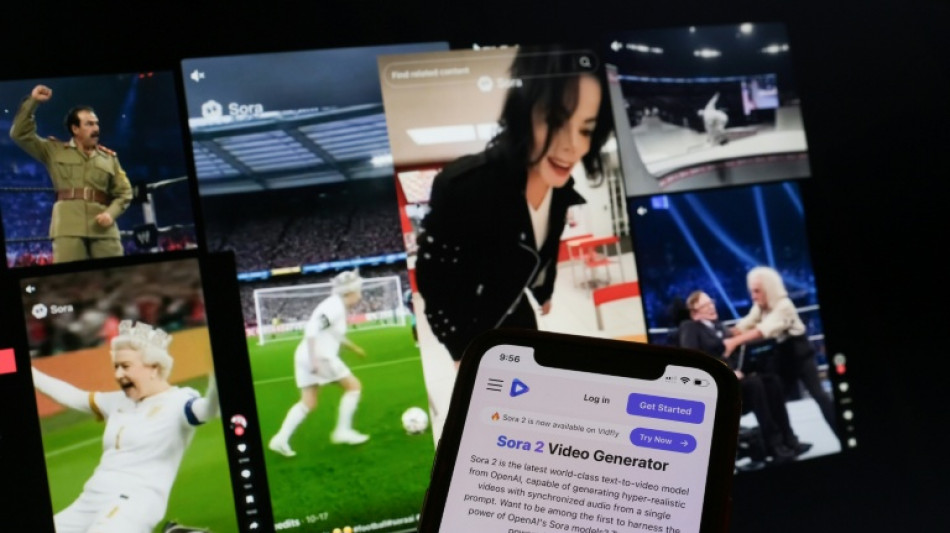
Online platforms offer filtering to fight AI slop / Photo: Chris DELMAS - AFP/File

 Maryland Regulators and Air Force Clash Over Jet Fuel Spill Cleanup and Golf Course Exemption

 Bishop Museum Races to Save Rare Megamouth Shark Specimen

 Musk Questions AI Development Viability as SpaceX Leasing Revenue Surges

 مصطفى معروفي ينشر قصيدة 'أصوغ كلامي أهتدي بتجاربي'

 Luxembourg Housing Petition Passes Threshold for Parliamentary Consideration

 Raheem Sterling Receives Suspended Sentence After Lamborghini Crash

 Audience to Choose the Set List at Luxembourg's First FAMIL Jukebox Night

 Luxembourg Pay Rise Delayed as Regional and World Headlines Develop

 مواجهة في البرازيل بين نشطاء وفلسطينيين وسياح إسرائيليين حول جدارية مؤيدة

 رئيس جامعة القدس يستعرض نموذج الشراكة بين التعليم العالي والصناعة في قمة QS بأبوظبي

 ابتكارات فلسطينية في مسابقة "سيف" العالمية بالرياض
As "AI slop" floods the internet, efforts are mounting to stem an online deluge of shoddy images and videos made using increasingly advanced tech tools.
Easily accessible generative artificial intelligence tools, such as Google's Veo and OpenAI's Sora, enable the creation of realistic imagery using just a few descriptive words.
Images of cats painting, celebrities in compromising situations, and cartoon characters endorsing products are among the AI-generated detritus proliferating on social networks and video-sharing platforms.
"The rise of AI has raised concerns about low-quality content — also known as AI slop," YouTube chief executive Neal Mohan said of the irksome phenomenon.
Such content is "cheap, bland and mass-produced," Swiss engineer Yves, who declined to give his last name, told AFP, echoing discussions on social media website Reddit.
Brands like Equinox gyms and Almond Breeze almond milk have played off AI slop frustration in recent ad campaigns, offering themselves as authentic, real alternatives.
Meanwhile, Microsoft chief executive Satya Nadella has urged people to move beyond the debate over whether AI creations are slop or sophistication to embracing the technology as a way to amplify creativity and productivity.
Microsoft is among the tech giants investing heavily in AI.
"At its core, the criticism of AI slop is the criticism of some individual's creative expression," argued Bob Doyle, a YouTube personality specializing in AI-driven media creation.
"You may think it's useless, but to them it's the beginning of an idea; a seed."
— Machine made —
However, online bulletin board Pinterest saw fit late last year to begin allowing users to filter out some AI-generated content.
Pinterest told AFP that it added the filter after hearing from people who wanted to see fewer synthetic images.
TikTok introduced a similar filter on its globally popular video platform late last year.
YouTube, along with Meta-owned Instagram and Facebook, also offers ways to reduce the amount of synthetic imagery their users encounter, but gives no clear-cut filter.
Major social media platforms had previously focused primarily on labeling AI-created videos so viewers would not mistake them for showing real scenes, but ample synthetic content seemed to avoid the labels.
Some smaller tech players, such as streaming platform Coda Music, have introduced measures such as having users report AI creations.
Once confirmed, accounts get labeled as AI artists so listeners know what they are getting, according to Coda founder and chief executive Randy Fusee.
"There has been a lot of participation in the identification of AI artists so far," Fusee told AFP.
"By and large, (Coda users) just don't want AI music."
Coda, which reports having some 2,500 users, offers the option of completely blocking AI content from suggested playlists.
Cara, a social network for artists and designers with more than a million users, relies on a combination of algorithms and human moderation to filter AI-generated content.
"People want the human connection," said Cara founder Jingna Zhang.
"I could like a child's drawing because I'm charmed by it, as opposed to (something made by) a machine with no intention."
Q.Najjar--SF-PST

