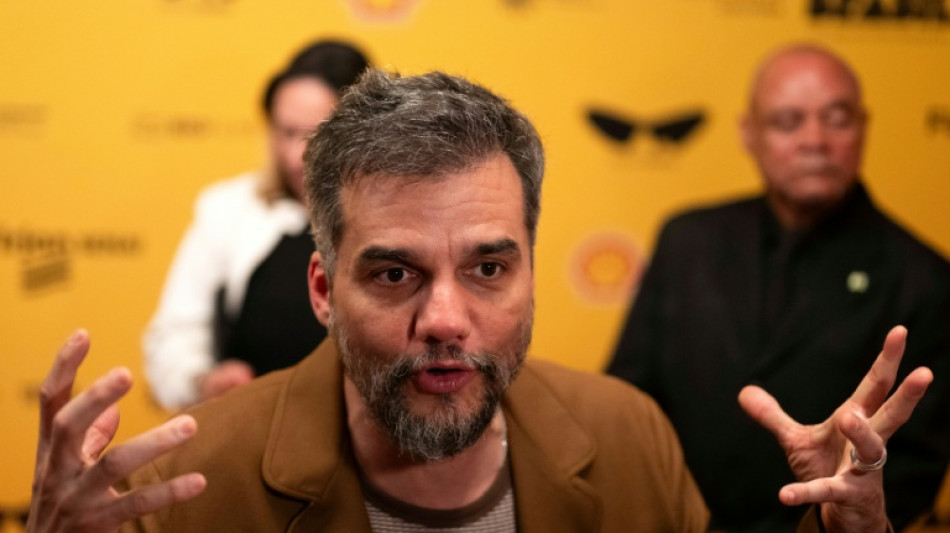
Lula revived Brazilian cinema, says 'The Secret Agent' director / Photo: Pablo PORCIUNCULA - AFP/File

 The British historian helping the French rediscover de Gaulle
 Dodgers beat Braves to advance, Guardians survive in MLB playoffs

 Latin American, Caribbean women top Nobel literature buzz
 US says Fiji-based Chinese official paid bribes for Beijing

 After botched US execution, Christa Pike was nearly taken off life support

 Guinea-Bissau junta urges military unit loyal to ex-president to disarm

 As species decline, green turtles offer glimmer of hope
 Brothers Scott and Beauden Barrett named to start for All Blacks
 EU trade chief seeks to dial down China tensions

 'Never again Bolsonaro': thousands march ahead of Brazil election runoff

 After botched execution, US woman was nearly taken off life support before revival
 Searing AIDS drama 'Elsinore' opens London film festival

 Evicted pensioner who sparked Spain housing protests dies: tenant union
 Golf star Rahm quitting LIV tour over 'unacceptable' terms
 Thousands march fearing return of a Bolsonaro presidency in Brazil
 French PM denies police ordered to confront student protesters

 Rubio touts US power, calls on Europe to emerge from 'slumber'

 Trump says 'we don't think' Russian plague is bio-weapon
 Five children among 26 killed in Ukraine after Russian strikes

 Man City should 'accept' punishment for rule breaches, says Lineker
 US woman who survived botched execution is awake and speaking
 From 1800s to modern pharma: a Nobel-winning chemistry quest

 Southampton boss Eckert given suspended ban over 'Spygate'
 Russia warns of 'false' information as second plague case reported
 IEA ready to release more oil reserves if necessary
Brazil's latest Oscar-nominated thriller "The Secret Agent" has resonated with audiences around the world as a universal tale of authoritarian regimes using their power "to crush people," director Kleber Mendonca Filho told AFP in an interview.
Following on "I'm Still Here," winner of last year's Oscar for Best Foreign Language Film, the new film about Brazil's 1964-1985 dictatorship has captivated Hollywood.
Fresh from winning two Golden Globes, the period thriller picked up four Oscar nominations on Thursday -- Best Picture, Best International Feature Film, Best Actor for Wagner Moura and Best Casting.
Mendonca Filho, the director of 2016's "Aquarius," about a woman refusing to be driven out of her home by developers, and 2019's anti-imperialism drama "Bacurau," links the current boom in the Brazilian film industry to the return to power of leftist President Luiz Inacio Lula da Silva in 2023.
Under Lula's far-right predecessor Jair Bolsonaro, "culture was extinguished in Brazil," he said.
Mendonca Filho spoke with AFP from Recife, his hometown in northeastern Brazil, where he received the news of the Oscar nominations.
In the film set in Recife, Moura -- of "Civil War," "Elite Squad" and "Narcos" fame -- plays a university professor recently arrived from Sao Paulo, who is unaware that he is being hunted by hitmen linked to the military regime.
Mendonca Filho lavished Moura with praise, saying "he's a great actor, a great artist and a great person. And he's exactly where he should be" among the nominees for best performance.
Below are excerpts from the interview, edited for clarity.
- How do you explain this moment in Brazilian cinema? -
"Brazilian cinema reconnected with the current with Lula's election in 2022, after four years in which culture, practically speaking, was extinguished in Brazil," Mendonca Filho said.
"The Ministry of Culture was eliminated. All support mechanisms were deactivated.
"(The) two films that were very well received in Brazil and internationally, 'I Am Still Here' and 'The Secret Agent,' became showcase films for Brazilian cinema."
- What's the global appeal of a film about Brazil's last dictatorship? -
"I think any story about the use of power to crush people will always be universal," Mendonca Filho said.
"The world today is the same one of wars, invasions, land grabs, the use of military or personal power, aggression and battles -- it's nothing new. What's shocking is that the same mistakes keep being made.
"When I wrote 'The Secret Agent,' I initially thought it would be set in 1977, but I began to realize that the film spoke a lot to the logic of Brazil in 2019 or 2021 (under Bolsonaro). A logic passed down from the past.
"In the midst of 21st-century democracy, a group of politicians decided to revive the iconography, the words, the methods and the lack of ethics of the military regime."
- How did US audiences receive the film? -
"The reaction is very positive. Many people in contemporary America can identify with its story. I think the reaction is largely due to the historical moment the United States is going through," Mendonca Filho said.
- Does cinema have a political role to play? -
"I don't see any obligation to make political films," Mendonca Filho said.
"If you make a film or tell a story honestly, frankly and knowledgeably, you will probably contribute to a better understanding of a country or society.
"My films have contributed to the debate in some way, but they weren't designed for that purpose.
"I don't make films to be symbols of resistance, but I believe that art, artistic expression, can function very well as a form of resistance."
O.Farraj--SF-PST