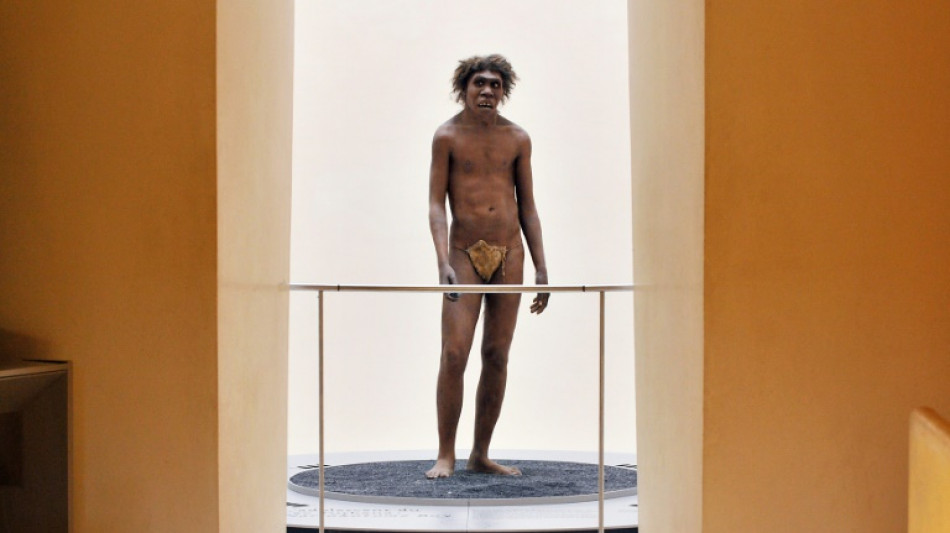
Fossils discovered in Morocco shed light on our African roots / Photo: PIERRE ANDRIEU - AFP/File

 Dodgers beat Braves to advance in MLB playoffs, Rays oust Yankees

 'A sun as black as my lungs': how corruption crucified a polluted Albania city

 The British historian helping the French rediscover de Gaulle

 Dodgers beat Braves to advance, Guardians survive in MLB playoffs

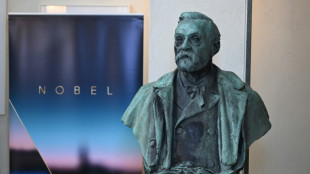 Latin American, Caribbean women top Nobel literature buzz

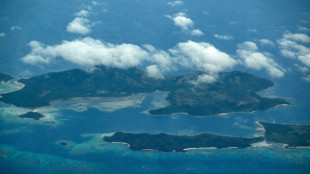 US says Fiji-based Chinese official paid bribes for Beijing

 After botched US execution, Christa Pike was nearly taken off life support

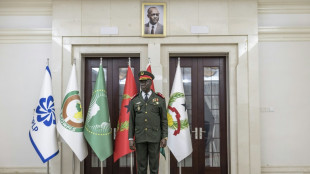 Guinea-Bissau junta urges military unit loyal to ex-president to disarm

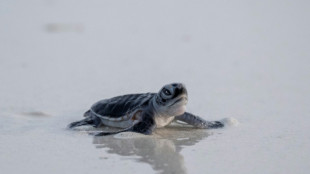 As species decline, green turtles offer glimmer of hope

 Brothers Scott and Beauden Barrett named to start for All Blacks

 EU trade chief seeks to dial down China tensions

 'Never again Bolsonaro': thousands march ahead of Brazil election runoff

 After botched execution, US woman was nearly taken off life support before revival

 Searing AIDS drama 'Elsinore' opens London film festival

 Evicted pensioner who sparked Spain housing protests dies: tenant union

 Golf star Rahm quitting LIV tour over 'unacceptable' terms

 Thousands march fearing return of a Bolsonaro presidency in Brazil

 French PM denies police ordered to confront student protesters

 Rubio touts US power, calls on Europe to emerge from 'slumber'

 Trump says 'we don't think' Russian plague is bio-weapon

 Five children among 26 killed in Ukraine after Russian strikes
 Man City should 'accept' punishment for rule breaches, says Lineker

 US woman who survived botched execution is awake and speaking

 From 1800s to modern pharma: a Nobel-winning chemistry quest

 Southampton boss Eckert given suspended ban over 'Spygate'

Where did our species first emerge? Fossils discovered in Morocco dating back more than 773,000 years bolster the theory that Homo sapiens originally appeared in Africa, scientists said in a study Wednesday.
The oldest Homo sapien fossils, dating from over 300,000 years ago, were found at the Jebel Irhoud northwest of Marrakesh.
Our cousins the Neanderthals mostly lived in Europe, while more recent additions to the family, the Denisovans, roamed Asia.
This has prompted an enduring mystery: who was the last common ancestor of Homo sapiens and our cousins, before the family tree split off into different branches?
This divergence is thought to have occurred between 550,000 and 750,000 years ago.
Until now, the main hominin fossils from around that time period were found in Atapuerca, Spain.
They belonged to a species dubbed "Homo antecessor", dated back around 800,000 years ago, and had features that were a mix of the older Homo erectus and those more similar to Homo sapiens and our cousins.
This sparked a contentious debate about whether our species originally emerged outside of Africa, before returning there.
There was "a gap in the fossil record of Africa", French paleoanthropologist and lead study author Jean-Jacques Hublin told AFP.
The research published in the journal Nature fills that gap by finally establishing a firm date for fossils discovered in 1969 inside a cave in the Moroccan city of Casablanca.
Over three decades, a French-Moroccan team unearthed hominin vertebrae, teeth and fragments of jaws that have puzzled researchers.
A slender lower jawbone discovered in 2008 proved particularly perplexing.
"Hominins who lived half a million or a million years generally didn't have small jawbones," Hublin said.
"We could clearly see that it was something unusual -- and we wondered how old it could be."
However numerous efforts to determine its age fell short.
- When Earth's magnetic field flipped -
Then the researchers tried a different approach.
Every once in a while, Earth's magnetic field flips. Until the last reversal -- 773,000 years ago -- our planet's magnetic north pole was near the geographic south pole.
Evidence of this change is still preserved in rocks around the world.
The Casablanca fossils were discovered in layers corresponding to the time of this reversal, allowing scientists to establish a "very, very precise" date, Hublin said.
This discovery eliminates the "absence of plausible ancestors" for Homo sapiens in Africa, he added.
Antonio Rosas, a researcher at Spain's National Museum of Natural Sciences, said it adds "weight to the increasingly prevalent idea" that the origins of both our species and the last common ancestor of Homo sapiens and Neanderthals/Denisovans lie in Africa.
"This work also suggests that the evolutionary divergence of the H. sapiens lineage might have started earlier than is conventionally assumed," Rosas, who was not involved in the research, commented in Nature.
Like Homo antecessor, the Casablanca fossils have a mix of characteristics from Homo erectus, ourselves and our cousins.
But while clearly closely related, the Moroccan and Spanish fossils are not the same, which Hublin said is a sign of "populations that are in the process of separating and differentiating".
The Middle East is considered to have been the main migration route for hominins out of Africa, however sinking sea levels at certain times could have allowed crossings between Tunisia and Sicily -- or across the Strait of Gibraltar.
So the Casablanca fossils are "another piece of evidence to support the hypothesis of possible exchanges" between North Africa and southwestern Europe, Hublin said.
F.AbuShamala--SF-PST