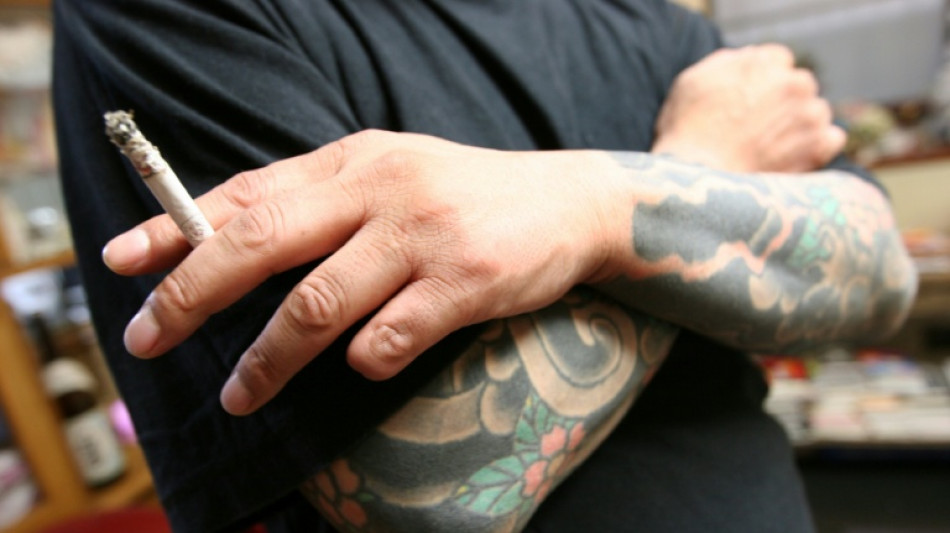
Upstart gangsters shake Japan's yakuza / Photo: Frank Zeller - AFP

 Dodgers beat Braves to advance in MLB playoffs, Rays oust Yankees

 'A sun as black as my lungs': how corruption crucified a polluted Albania city

 The British historian helping the French rediscover de Gaulle
 Dodgers beat Braves to advance, Guardians survive in MLB playoffs
 Latin American, Caribbean women top Nobel literature buzz
 US says Fiji-based Chinese official paid bribes for Beijing

 After botched US execution, Christa Pike was nearly taken off life support

 Guinea-Bissau junta urges military unit loyal to ex-president to disarm

 As species decline, green turtles offer glimmer of hope
 Brothers Scott and Beauden Barrett named to start for All Blacks

 EU trade chief seeks to dial down China tensions

 'Never again Bolsonaro': thousands march ahead of Brazil election runoff

 After botched execution, US woman was nearly taken off life support before revival
 Searing AIDS drama 'Elsinore' opens London film festival

 Evicted pensioner who sparked Spain housing protests dies: tenant union

 Golf star Rahm quitting LIV tour over 'unacceptable' terms
 Thousands march fearing return of a Bolsonaro presidency in Brazil

 French PM denies police ordered to confront student protesters

 Rubio touts US power, calls on Europe to emerge from 'slumber'

 Trump says 'we don't think' Russian plague is bio-weapon

 Five children among 26 killed in Ukraine after Russian strikes

 Man City should 'accept' punishment for rule breaches, says Lineker

 US woman who survived botched execution is awake and speaking
 From 1800s to modern pharma: a Nobel-winning chemistry quest

 Southampton boss Eckert given suspended ban over 'Spygate'
When Takanori Kuzuoka began climbing the criminal career ladder, he didn't fancy joining Japan's old-school yakuza, with their tattoos, rigid hierarchy and codes of honour.
Instead he was drawn to the newer, tech-savvy "tokuryu" underworld, where shadowy criminal kingpins use social media and encrypted messages to recruit often naive foot soldiers to do their dirty work.
This new brand of Japanese organised crime has grown fast by creating its own criminal gig economy -- with bosses insulated from arrest by disposable minions.
Kuzuoka gave AFP an extraordinary insight into the tokuryu mindset in a five-month exchange of handwritten letters from his prison cell.
While the yakuza used to pride themselves on not preying on the poor and weak, the tokuryu have no such scruples.
They make much of their millions from conning Japan's ageing population, while the yakuza -- whose multi-billion-dollar empire is shrinking after years of strict anti-mafia laws -- have traditionally scorned such fraud as dishonourable.
Despite their disdain for the new kids on the block, a high-ranking gangster allied to a major yakuza clan privately admitted to AFP that they were "losing their allure for young people".
"Fewer recruits are signing up," with millennials and Generation Zers not prepared to start at the bottom and work their way up, he said, in an interview that took months to set up.
They "come to us fantasising about the glitz and glamour of our world and quickly find the reality is not what they imagined," he said.
They "don't like being shackled" by its rules and rituals so "they're increasingly choosing tokuryu instead", he added.
- 'Ridiculously gullible' recruits -
"I never understood what on earth can be the benefit of being a yakuza these days," Kuzuoka told AFP after we tracked him down to a jail in northern Japan after sending letters to more than 30 prisons across the country.
In neat handwriting, the 28-year-old wrote back, recounting how he had graduated to organised crime from teen "bosozoku" biker gangs, before becoming a "multi-tasking" recruiter, coordinator and perpetrator of a slew of tokuryu operations.
At times he said he worked closely with the shadowy ringleaders, whose identities were hidden even from him.
"Every single day countless people took the bait on fishy adverts I posted" on X for "high-paying" jobs, he said.
The expendable amateurs he worked alongside included a sex worker, a gambling addict and a boy band member, all of whom had signed up for "yami baito" -- black market part-time jobs.
"I couldn't help but feel how ridiculously gullible they were," he said.
With their ruthlessness, elusive leadership and online recruitment, the tokuryu resemble a new wave of organised crime networks that have been terrorising Sweden and the Chinese-led crime syndicates running industrial-scale scams from Myanmar and Cambodia.
The core tokuryu crimes of scams and organised fraud cost Japan 72.2 billion yen ($474 million) between January and July, outstripping the record losses for the whole of last year.
Tokyo police -- who called them their "biggest public order priority" -- set up a 100-officer taskforce in October to "destroy" the groups.
Tokuryu, which means "anonymous and fluid", hire recruits into "project teams" to commit specific crimes, according to retired anti-mob detective Yuichi Sakurai.
These low-level operatives split and merge with "amoeba-like" fluidity that means "arrests rarely lead to the leadership", Sakurai told AFP.
While tokuryu are involved in robberies and violence, scams are their bread and butter, particularly the "It's me!" con.
This involves fraudsters ringing up elderly people pretending to be their children or grandchildren, begging for money because they messed up and would bring shame on the family.
They are also masters of highly sophisticated costume cons, where they dress up to impersonate police officers, bank officials and civil servants to swindle victims -- some of them fed their lines from afar via Bluetooth earphones.
But things can also get very ugly, as Kuzuoka admitted. Armed with scissors, he led a gang of robbers that attacked a mother, binding her two terrified children with tape as he forced her to hand over 30 million yen ($191,000) in cash.
- Yakuza 'code of chivalry' -
All of which disgusts the yakuza who -- though not shy about using violence, cutting off members' fingers as punishment -- claim to have limits.
"I fought a lot and killed someone, but I never bullied the weak," one former yakuza from the central city of Gifu told AFP.
He spent 15 years behind bars for murdering a rival gangster but called scamming vulnerable old people "unthinkable".
"It's a great deviation from our traditional code of chivalry," said the ex-mobster, now in his 70s.
"Help the weak, fight the strong," was the mantra which he said he lived by.
Yakuza have long occupied a particular place in Japanese society. Technically not illegal, each group even has its own official headquarters.
Having thrived in the bedlam of post-war Japan, they ruled the underworld through drug rings, illicit gambling dens and the sex trade, and also made forays into legitimate business such as real estate, entertainment and waste management.
Yakuza also saw themselves as having a social role, operating as shadow enforcers in grey areas where police and the judicial system were absent.
A caste apart, marked out by their full-body tattoos, punch perms and flashy suits, they are a staple of popular culture from manga to TV series.
"Everywhere yakuza went, people would bow down to them. I was awestruck," ex-gangster Yoshiro Nishino, who joined as a teenage outcast, told AFP.
Initiation rituals like the exchange of sake cups with his group's patriarch created pseudo-familial bonds "stronger than actual blood, making me feel I was accepted," Nishino said.
From expensive cars to Louis Vuitton bags, the mobsters dazzled the young Nishino.
Yakuza are "all about vanity", said the 47-year-old, who now runs a home for ex-offenders near Tokyo.
"I was often told, 'You're finished as yakuza if you can't put on a show of pride.'"
Anti-gang laws in 1992 essentially allowed the mobs to exist openly in exchange for more surveillance over their activities.
But crackdowns followed as tolerance waned, culminating in 2011 laws that sought to "exclude" the mobsters from a raft of basic services.
This left them unable to legally open bank accounts, rent housing, obtain credit cards or even get cellphone contracts.
Last year their numbers hit a record low of 18,800, down nearly 80 percent from 1992.
- Rise of 'hangure'-
The gap has been filled over the past decade by the "hangure", or "quasi-yakuza".
Kuzuoka came up through these more loosely knit gangs of young delinquents bound not by hierarchy but by camaraderie.
As hangure, "you can easily pass off as an ordinary citizen", he said.
Unlike yakuza, you can "openly go into legitimate businesses like running martial arts contests, beauty salons or fashion brands," he said.
Much of the tokuryu is led by hangure, the authorities believe.
While the leaders have a certain loyalty to each other, lower-ranking troops hired online are "total strangers to each other", Kuzuoka told AFP.
"Their relationships can easily unravel, leading to betrayals such as abandoning each other or shifting blame."
But for all their outward contempt for the younger arrivistes, money is driving some yakuza to align with tokuryu groups, police believe.
"We have confirmed some of the proceeds from tokuryu crimes are going to yakuza organisations," Tokyo police told AFP, adding that the old mafia remains "a serious threat to public safety".
- 'We're needed' -
Former detective Sakurai said that while yakuza may not actively plot fraud or theft, some take a cut of hangure profits.
"'No way in hell you will make money behind our backs,' yakuza warn them," he said.
In return they offer the muscle to "shield" tokuryu leaders from trouble, Sakurai added.
But Yukio Yamanouchi, a former lawyer for Yamaguchi-gumi, by far the largest yakuza clan with 6,900 members and associates, told AFP that the links may go deeper.
"I believe that some rank-and-file (yakuza) have indeed resorted to scams because they are genuinely struggling to make ends meet. That's how scarce the business opportunities are for them," he added.
This despite the clan's leadership repeatedly warning members not to get involved in fraud, the lawyer said.
"Making money by deceiving people is not what yakuza are supposed to do," the senior yakuza told AFP.
Whatever challenges they face, he is confident the yakuza will survive, providing protection from other criminal forces and what he calls the "gangs of Southeast Asian thieves" blamed for much petty crime in Japan.
"We're needed in society," he insisted. "There is no way we will go extinct."
Serving nine years for the violent robbery he committed in Tokyo in 2022, Kuzuoka has had a lot of time to reflect on what he did "in cold blood" and on the troubled childhood that led him there.
Life in the underworld "distorted me", he said, allowing him to be "almost emotionless". But "I see now what a cruel, demonic and inhumane thing we did", he wrote.
"I will carry my sins for the rest of my life."
J.Saleh--SF-PST