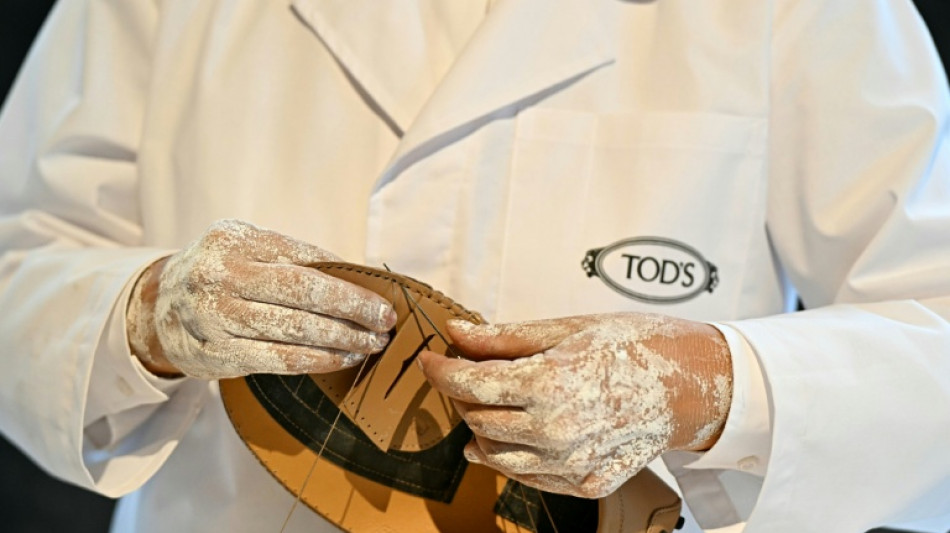
Italy's luxury brands shaken by sweatshop probes / Photo: Gabriel BOUYS - AFP/File

 فاطمة بوش ترفع شعار 'ليحيا المسيح الملك' في ختام ملكة جمال الكون

 أين الأمن القومي العربي؟.. تحليل نقدي لغياب الرؤية المشتركة

 Crude Oil Prices Rise on Reports of Houthi Attack on Saudi Refinery

 El Nino’s Weakening Grip on Tamil Nadu Rainfall Hinges on Potential Cyclone

 Black Friday Discounts Cut Prices on Two Top-Rated Wiper Blades

 Twickenham Grounds Team Prepares Pitch for Six Matches in Three Days

 Luxembourg City Plans €13 Million Abrigado Centre for 2029

 Two A1 Crashes Create Kilometres of Rush-Hour Congestion

 South Africa Places 36 Hospitals on Standby for Possible Imported Ebola Cases

 Tamil Nadu Secures Rs 58,214 Crore in Investments at Vettri Conclave

 فرنسا تدعو لتجريم "الفصل العنصري القائم على الجنس" دولياً
A series of investigations into exploitative work conditions within fashion subcontractors has roiled Italy's luxury industry, with the government decrying attacks on "Made in Italy".
Five fashion brands have been put under court administration since 2024 following probes by Milan prosecutors that uncovered worker abuses and a lack of oversight into the supply chains of some of Italy's most respected brands.
Most recently, lawyers for luxury leather company Tod's were due in a Milan court Wednesday, where prosecutors want to impose a temporary advertising ban and outside administrators in light of what they have called "malicious" actions by the company.
The investigations led by prosecutor Paolo Storari have cast a spotlight on the dark underside of the luxury industry.
At issue is the near-ubiquitous practice of brands subcontracting work to suppliers, who in turn contract to others, amid ever-tighter margins and scant oversight of labour conditions.
To date, investigations have targeted Loro Piana, Dior's Italian subsidiary Manufactures Dior, Giorgio Armani Operations and Alviero Martini -- and prosecutors have suggested more probes could come.
Italy's government has gone on the offensive, with Industry Minister Adolfo Urso saying the reputation of Italian brands was "under attack".
It has proposed a certificate for luxury companies to show they are in compliance with current law -- a measure critics have called toothless, in part because it is voluntary and would unduly shield brands from liability.
"We are taking concrete measures to firmly defend Italian fashion, to protect its reputation and the values that have made it synonymous with beauty, quality and authenticity," Urso said in October.
- 'Chain of exploitation' -
Prosecutors last month said Tod's -- whose leather loafers can reach over $1,000 -- and three of its executives had "full awareness" of the exploitation of Chinese subcontractors but failed to set up systems to prevent it.
Tod's allegedly ignored its own audits revealing working hours and wage violations -- with workers paid as little as 2.75 euros per hour -- breaches of safety measures and what prosecutors called "degrading" sleeping areas within the factory.
Under Italian law, companies can be held responsible for offences committed by representatives -- such as approved suppliers -- acting in their interest.
Advocates for fashion industry workers have for decades pointed to widespread abuses in the supply chain.
Suppliers "are at the mercy of big brands that impose commercial conditions, starting with prices that are too low to cover all costs", said Deborah Lucchetti, national coordinator of the Clean Clothes Campaign in Italy.
That, in turn, fuels a system in which first-tier suppliers turn to subcontractors, imposing ever more stringent terms, which leads to labour abuses, most often against migrants.
"It's a chain of exploitation," she told AFP.
Italy's fashion suppliers are predominately small- and medium-sized companies, tens of thousands of whom have shuttered in recent years, according to industry associations, amid a luxury downturn and higher production costs.
Unable to invest, due to lack of guaranteed work from the commissioning brands and hyper-thin margins, the suppliers stay small. When a big order arrives, they turn to subcontractors for quick help, a system that "effectively pushes players in the supply chain to engage in illegal conduct", said Lucchetti.
Prosecutors said both Tod's and Loro Piana could not have been unaware that one of their main suppliers was externalising all its production -- given that the supplier did not have any production equipment, such as sewing machines, in its facility.
The companies targeted thus far have variously responded by cutting ties with the suppliers, condemning their actions, or blaming them for concealing abuses.
- Reputational risk -
Amid the reputational risk, some brands have sought to reassure consumers.
Last week, one of Italy's top luxury brands, Prada, invited journalists to its Scandicci factory outside Florence, showing the step-by-step transformation of supple leather into luxury handbags.
Asked about the investigations, Prada's Chief Marketing Officer Lorenzo Bertelli, who also heads social responsibility, said production had never been an afterthought for the company.
Other fashion executives, Bertelli said, don't view production "as an area of responsibility": "And this has led to many of things you have read in the newspapers."
Prada does not disclose how much of its production is in-house, but says it is the highest in the industry. Prada owns 25 factories, 23 of which are located in Italy.
Bertelli called it a "constant battle" to keep Prada's supply chain clean.
"We must constantly carry out inspections or checks on suppliers, this is the daily work we do."
O.Salim--SF-PST

