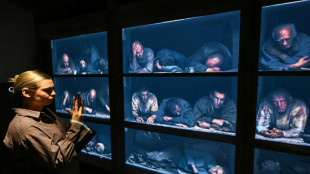
Driven by TikTok trends, new beauty brands target children / Photo: Earl Gibson III - GETTY IMAGES NORTH AMERICA/AFP

 Morikawa says LIV players face 'business decision' after Rahm exit

 Tenzing Norgay's son says Himalayas sending climate warning

 On your bike! Bottas opts for two wheels to reach Singapore GP

 Alcaraz, Sinner, Osaka commit to Australian Open '1 Point Slam'

 Dodgers beat Braves to advance in MLB playoffs, Rays oust Yankees

 'A sun as black as my lungs': how corruption crucified a polluted Albania city

 The British historian helping the French rediscover de Gaulle

 Dodgers beat Braves to advance, Guardians survive in MLB playoffs

 Latin American, Caribbean women top Nobel literature buzz

 US says Fiji-based Chinese official paid bribes for Beijing

 After botched US execution, Christa Pike was nearly taken off life support

 Guinea-Bissau junta urges military unit loyal to ex-president to disarm

 As species decline, green turtles offer glimmer of hope

 Brothers Scott and Beauden Barrett named to start for All Blacks

 EU trade chief seeks to dial down China tensions

 'Never again Bolsonaro': thousands march ahead of Brazil election runoff

 After botched execution, US woman was nearly taken off life support before revival

 Searing AIDS drama 'Elsinore' opens London film festival

 Evicted pensioner who sparked Spain housing protests dies: tenant union

 Golf star Rahm quitting LIV tour over 'unacceptable' terms

 Thousands march fearing return of a Bolsonaro presidency in Brazil

 French PM denies police ordered to confront student protesters

 Rubio touts US power, calls on Europe to emerge from 'slumber'

 Trump says 'we don't think' Russian plague is bio-weapon

 Five children among 26 killed in Ukraine after Russian strikes

Should children be using beauty face masks? Dermatologists say no, but a growing number of companies are targeting a new generation of kids who have grown up with TikTok skincare and make-up routines.
The cosmetics industry and parts of the internet have been abuzz since the launch of Rini earlier this month, a beauty company pitched at children as young as three and backed by Canadian actress Shay Mitchell.
Its bundle of five child hydrating face masks, including "everyday" varieties named Puppy, Panda, and Unicorn, sells for around 35 dollars (30 euros) on its website.
Another growing US-based brand, Evereden, sells products for pre-teens such as face-mists, toners and moisturisers and claims annual sales of over 100 million dollars.
Fifteen-year-old American YouTuber Salish Matter unveiled her brand Sincerely Yours in October, drawing tens of thousands of people -- and police reinforcements -- to a launch event at a New Jersey mall.
"Children's skin does not need cosmetics, apart from daily hygiene products -- toothpaste and shower gel -- and sun cream when there is exposure," said Laurence Coiffard, a researcher at the University of Nantes in France who co-runs the Cosmetics Watch website.
Child-focused beauty products are part of a broad society-wide trend.
Many girls in Gen Alpha -- a marketing term for youngsters born between 2010 and 2024 -- are adopting skincare, make-up and hair routines more typical of older teenagers or their mothers.
The most precocious have become known as "Sephora Kids" -- a reference to the popular French beauty retailer -- as they seek to copy popular TikTok or YouTube influencers, some of whom are as young as seven.
Coiffard cited research showing child users of adult cosmetics and creams had a higher risk of developing skin allergies in later life, as well as being exposed to endocrine disruptors and phytoestrogens which can disrupt hormone development.
- 'Get Ready with Me' -
Molly Hales, an American dermatologist at Northwestern University in Chicago, spent several months posing on TikTok as a girl of 13 who was interested in beauty routines.
After creating a profile and liking several videos made by minors, the algorithm of the Chinese-owned site "saturated" her and fellow researcher Sarah Rigali.
The duo went on to watch 100 videos in total from 82 different profiles.
In one, a child smeared 14 different products on her face before developing a burning rash.
Another showed a girl supposedly rising at 4:30 am to complete her skincare and make-up routine before school.
The most popular videos were titled "Get Ready with Me", with the routines featuring on average six different products, often including adult anti-ageing creams, with an average combined cost of 168 dollars.
"I was shocked by the scope of what I was seeing in these videos, especially the sheer number of products that these girls were using," Hales told AFP.
Her research was published in US journal Pediatrics in June.
Several "disproportionately represented" brands, such as Glow, Drunk Elephant or The Ordinary, market themselves as healthy, supposedly natural alternatives to chemical-laden competitors.
The top 25 most-viewed videos analysed by Hales contained products with an average of 11 and a maximum of 21 potentially irritating active ingredients for pediatric skin.
- 'Not necessary' -
The pitch from new child brands such as Rini, Evereden or Saint Crewe is that they are orienting tweens and teens to more suitable alternatives.
"Kids are naturally curious and instead of ignoring that, we can embrace it. With safe, gentle products parents can trust," Rini co-founder Mitchell told her 35 million Instagram followers.
Hales said she had "mixed feelings" about the emergence of the trend, saying there was a potential benefit of providing less harmful products to young girls.
But they are "really not necessary" and "perpetuate a certain standard of beauty, or an expectation around how one needs to care for the health and beauty of the skin by using a very costly and time-intensive daily routine", she said.
The products risked "steering girls away from better uses of their time, money and effort", she added.
Pierre Vabres, a member of the French Society of Dermatology, believes there is also a pernicious psychological effect of exposing children to beauty routines -- and then seeking to sell them products.
"There's a risk of giving the child a false image of themelves, even eroticised, in which they are 'an adult in miniature' who needs to think about their appearance in order to feel good," he told journalists in Paris this month.
M.AbuKhalil--SF-PST