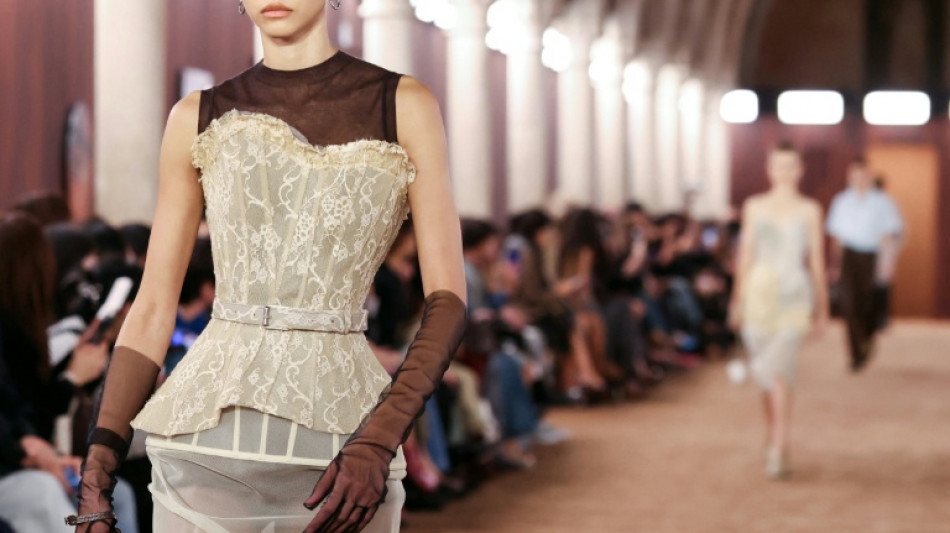
Thinness is back on catwalks -- and the data proves it / Photo: Alain JOCARD - AFP

 فاطمة بوش ترفع شعار 'ليحيا المسيح الملك' في ختام ملكة جمال الكون

 أين الأمن القومي العربي؟.. تحليل نقدي لغياب الرؤية المشتركة

 Crude Oil Prices Rise on Reports of Houthi Attack on Saudi Refinery

 El Nino’s Weakening Grip on Tamil Nadu Rainfall Hinges on Potential Cyclone

 Black Friday Discounts Cut Prices on Two Top-Rated Wiper Blades

 Twickenham Grounds Team Prepares Pitch for Six Matches in Three Days

 Luxembourg City Plans €13 Million Abrigado Centre for 2029

 Two A1 Crashes Create Kilometres of Rush-Hour Congestion

 South Africa Places 36 Hospitals on Standby for Possible Imported Ebola Cases

 Tamil Nadu Secures Rs 58,214 Crore in Investments at Vettri Conclave

 فرنسا تدعو لتجريم "الفصل العنصري القائم على الجنس" دولياً
After a short interlude of pushing "body inclusivity" and plus-sized models to the fore, the fashion industry has returned to promoting thinness as a beauty ideal.
Data published this week from Vogue Business, based on catwalk shows in the most recent Spring/Summer 2026 Fashion Weeks, corroborated what models with regular or larger body sizes have been reporting: their work is drying up.
Of the 9,038 looks analysed in New York, London, Milan and Paris, 97.1 percent featured models judged to be very small (US 0-4, UK 4-8 or 32-36 in France), according to data from Vogue Business in its size inclusivity report.
Regular-sized models represented only 2.0 percent of the body types seen, compared to just 0.9 percent for "plus-size" models (US 14+, UK 18+, France 44+), the report showed.
"There are fewer and fewer plus-size models on the runways," Aude Perceval, a booker at Plus Agency, a pioneer in plus-size modeling in France, told AFP.
The trend was particularly pronounced in Paris, she added.
This is despite many designers adopting looks that naturally create curvy silhouettes, such as corsets.
In some cases, models have been sent out with padding around their hips to create the hourglass shape.
"Since 2022, there's been a real regression, both in the frequency of contracts and in fees," model Doralyse Brumain, 31, who wears a French 40-42, told AFP.
- 'False idea' -
The "body positive" movement, born in the 2010s, was based on the idea of promoting acceptance of different body types and recognising the damage done by creating a beauty ideal of thinness that was both unhealthy and beyond the reach of most women.
In the same way that fur and flashy fashion is making a comeback, so is the aesthetic of extreme thinness that was called "heroin chic" in the 1990s when popularised by supermodels such as Kate Moss.
"There's this false idea that being thin means being chic, being rich," said French model casting director Esther Boiteux to AFP.
The wide availability of weight-loss drugs such as Ozempic -- used to suppress appetite -- has also been linked to the return of thinness.
The diabetes treatment "has something to do with it because we're seeing a lot of celebrities who are using it", British Vogue editor Chioma Nnadi said last November.
"I think there's this shift in the culture around how we think about our bodies and how we address our bodies," she told the BBC.
Clothes for fashion shows are also typically designed and manufactured in a single size -- that of "standard" thin models -- and making clothes for regular or larger models requires forethought and extra time to adapt them.
- 'Unattainable' -
Ekaterina Ozhiganova, a Russian-born model and founder of the Model Law association, which advocates for model rights, says that consumers are in favour of seeing models in different sizes.
"But for it to become truly sustainable, there would need to be a profound change in production," she told AFP, adding that the industry continued to sell "an unattainable ideal".
French designer Jeanne Friot believes fashion runways should instead be a place where everyone can envision themselves.
"The point of a fashion show is to showcase something different from the fashion I grew up with, very thin and very standardized. I want to see (larger) sizes... older people, all ethnicities, all genders," she told AFP.
For the moment, sighting a regular-sized woman on the catwalk is an increasingly rare occurrence, but the change is not going unnoticed.
"We have to speak out when fashion messes up and establishes a standard it should abandon," French fashion journalist Sophie Fontanel wrote on Instagram in early October as she watched the Givenchy show during Paris Fashion Week.
N.Awad--SF-PST

