'Let the light in': Romanian Roma actress smashes stigma with new play

 Hotel Blacklist Launches New Accommodation Industry Risk Assessment Tool

 Bangladesh nuclear plant draws hope -- and worry

 US beat Canada 1-0 to wrap up four-win international break

 Turkey, Australia's joint COP31 leadership raises doubts

 For Turkish NGOs, COP31 offers rare space for action
 Sleep, appetite, gene-editing experts contend for Nobel chemistry prize

 Nobel Peace Prize haunted by the 'spectre' of Trump

 Africa launches own credit agency in bid for cheaper borrowing

 US, China, EU: three paths to regulating AI

 Australia's High Court rules against coal mine in landmark climate case

 Australia touts new funds for Pacific infrastructure at Fiji 'pre-COP'

 Eva Marie Saint, Oscar winner of Hollywood classics, dies at 102

 Australia probes app used in cheap smart glasses over privacy fears

 England needed to 'move on' from World Cup pain, says Tuchel

 O'Neill to stay at Celtic after period of "reflection"

 Kane marks 125th England cap with Wembley Nations League double

 Quebec's incoming separatist leader wants to block Crown from swearing-in

 Emmys gala will now stream its premier television awards

 Paramount completes Warner Bros takeover, creating Skydance
 Trump blames France unrest on Islam, migration

 Apple's Cook praises EU over efforts to protect children online
 Nobel winner Halzen says years of October 'misery' finally over
 Quebec separatist win rattles Carney's unity push

 'Itching' for change: Shiffrin cuts back slaloms this season

 'Gen Z has risen up': Tens of thousands mass for tense France school protests

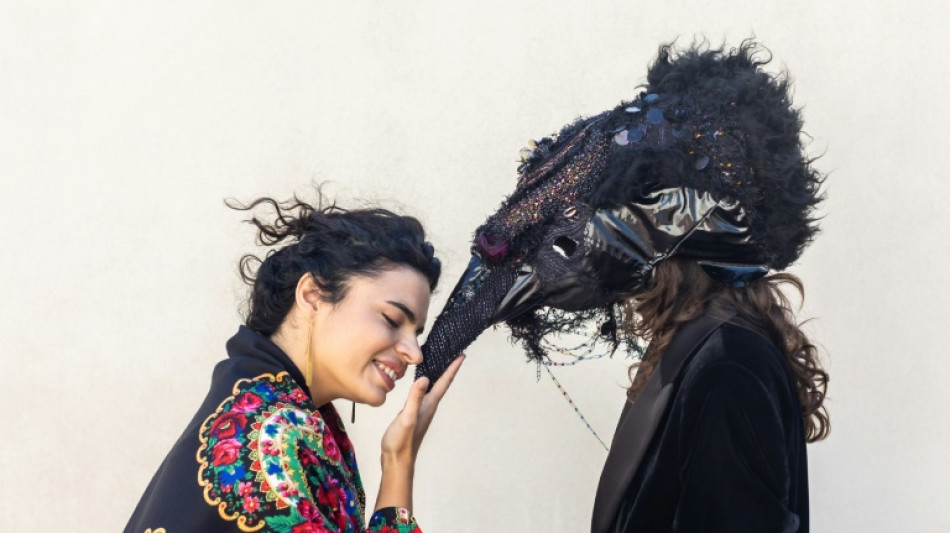
As a child, Roma actress and playwright Alina Serban didn't see herself represented on television, in movies or books, her stigmatised community shunned from the cultural mainstream.
She has dedicated her career to changing that, and last month became the first Roma to stage her work at Bucharest's National Theatre.
"I grew up in this country, but I've never been able to recognise myself in the stories," the 34-year-old told AFP.
"That's why it's important for me to crack open the door and let the light in. It's like I'm planting a flag," she adds, speaking between rehearsals.
Her show, called "Cel mai bun copil din lume" (The Best Child in the World) and based on her life, opened on January 21 to sold out audiences.
It is a moving and at times funny story about a girl who triumphs against all odds, but can't escape the stigma she faces as a Roma.
"This is the first time that a Roma story, written, staged and performed by a Roma artist has been welcomed on the national scene," she says.
- 'She's a gypsy' -
Romania, one of the poorest countries in the European Union, has the largest Roma minority in Europe, around two million strong, according to NGOs.
But many Roma are reluctant to identify themselves as such for fear of discrimination. Officially they are only 621,000 out of Romania's population of 19 million.
Serban says she started to realise her Roma identity at age nine when she and her parents, beset by financial difficulties, had to leave their apartment in a working-class Bucharest district.
They settled in a cob house without running water, alongside her aunts and uncles.
That's when she heard a remark at school that will haunt her forever: "She's not Romanian, she's a gypsy".
The pejorative word "gypsy" is often replaced by "crow" in Romanian.
It's a reference Serban uses in her play: she wears a black feather crow mask that she cannot shake off.
Tired of having to hide where she lived, she promised herself she would get out of the "slum".
She became the first in her family to graduate from high school and was then admitted to Bucharest's prestigious Academy of Theatre and Cinema.
She followed up with studies in New York and London financed by grants.
Serban won acclaim on the international stage, including for her roles in the 2019 movie "Gipsy Queen" about a struggling single mother who fights in the ring, and the 2018 Belgian film "Alone at My Wedding".
- Overcoming self-hate -
But "that was not enough", she says. She continued to be shaken by self-doubt.
"The problem with racism is that the hate that others project on you becomes self-hate. And you end up suffering from impostor syndrome," Serban says.
Among her many projects is a feature film on Roma slavery -- a dark page in Romania's history which Serban has already explored in a play "Marea rusine" (The Great Shame).
For centuries, the traditionally nomadic minority was reduced to slavery -- until that was abolished in 1856 -- and then subjected to forced assimilation under communism.
Even today, racism continues, and Roma access to employment and housing is difficult.
According to opinion polls published in 2018 and 2020, seven in 10 Romanians say they "do not trust the Roma".
- 'Change the world' -
Despite everything, the artist sees reasons for hope as Roma culture becomes "cool" among the younger generation.
More open to diversity, they are interested in Roma music and fashion, while school textbooks have started mentioning the enslavement of Roma, according to sociologist Adrian Furtuna.
"There is beginning to be an awareness" of what the Roma have endured, he told AFP.
Holding back tears, Serban says that by openly talking about her Roma identity she "endangered" her mother, who could have lost her job as a cleaner or been evicted.
"If I continue, it's because at the end of the films or plays in which I act, I see a gleam in the eyes of the spectators," Serban says.
"I am convinced that I can change the world with the stories I tell".
R.Halabi--SF-PST