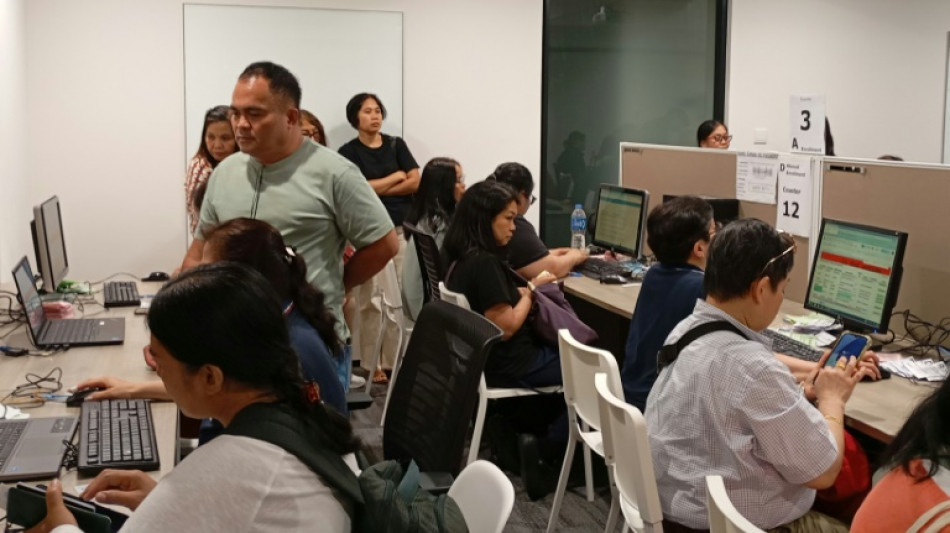
Digital voting breeds distrust among overseas Filipino workers / Photo: Purple ROMERO - AFP

 'Tough to stay here': Nepal flood survivors wait for homes

 Malaysia closes schools in capital, parts of country due to haze
 Buccaneers stun Cowboys for first win of NFL season
 Activists hope trial will stop 'forever chemicals' at Italy plant
 Guardians rally for 9-5 victory over White Sox to stay alive in MLB playoffs

 Asian stocks mixed amid AI concerns, oil dips after surge

 Wallabies expect fast-paced All Blacks in Bledisloe opener
 Tech scammer Elizabeth Holmes focus of documentary by absurdist Nathan Fielder

 Climate hopes shift from politics to the courts

 Will Nobel Peace Prize pick make waves at the White House?

 Trump rules out new Iran attack before US midterm elections

 Far-right influencer shows Israel's coarse political turn

 Seals and sea lions get hearing tested at Australia zoo

 Mourinho's Real Madrid playing catch-up in Clasico countdown

 Joy as USS Lincoln back home after troubled Gulf deployment
 OpenAI says Iran, Russia influence ops busted
 Anthropic bans 'cruel' behavior against its Claude AI

 Anne Carson's Nobel literature prize 'a proud moment for Canada': PM

 Montagliani to seek CONCACAF re-election in boost for Infantino: reports

 Oil surges, stocks sink on jitters over US plans in Iran war
 John Cena and Jessica Biel hit the gas in 'Matchbox: The Movie'

 US, Ukrainians, Europeans to discuss 'new ideas' to end war
 Unproven 'cures' pushed online amid plague concerns

 Nigeria looks to ease fuel prices as election looms

 Prosecutors in Maradona death trial seek sentences up to 12 years

A new online voting system aimed at boosting turnout among the Philippines' millions of overseas workers ahead of Monday's mid-term elections has been marked by confusion and fears of disenfranchisement.
Thousands of overseas Filipino workers, or OFWs, have already cast their ballots in the race dominated by a bitter feud between President Ferdinand Marcos and his impeached vice president Sara Duterte.
While official turnout figures are not yet publicly available, data from the Commission on Elections (Comelec) show at least 134,000 of the 1.22 million registered overseas voters have signed up for the new online system, which opened April 13.
But Jun Burlasa III, a Filipino working in Singapore, says he will not vote again if he has to do it online.
"I'd rather do manual," the 50-year-old told AFP this week, describing the new system as "confusing and suspicious".
At issue is a digital QR code generated after voting that leads users to a page asking them to verify their ballot has been submitted correctly. Below that is a box containing a jumble of computer code and candidate names.
Burlasa said many of the names visible were candidates for whom he had not voted.
Similar stories about the anxiety-inducing webpage have proliferated across social media, including Facebook posts that have reached thousands.
Eman Villanueva, a Hong Kong-based activist with migrant rights group BAYAN, said he was unsure his vote had been properly counted.
"There is absolutely no way for the voters to know if the votes that went through really reflected our choices," he said.
In previous overseas elections, voters could review the names they selected after the fact, but Comelec told AFP the QR code was never supposed to serve that purpose.
The landing page was only intended to verify a ballot's receipt, the commission said, adding that the name of every candidate running in the election should appear.
"We are definitely considering the feedback and studying how to incorporate them in future elections," Ian Geonanga, Comelec's director of overseas voting, told AFP.
Election watchdogs, however, say the commission failed to properly explain the new system and warn of the confusion risks disenfranchising voters.
"It's a natural reaction of people that if you're not familiar with the system, then you won't trust it the first instance," said Ona Caritos, executive director of the nonprofit Legal Network for Truthful Elections (Lente).
- ChatGPT, disinfo and 2028 -
Since April 14, 1.5 million people have watched a video in which a Philippines-based engineer named Jaydee San Juan quizzes ChatGPT about the names visible on the ballot verification page.
"It's highly likely showing the candidates that were selected/voted for using that ballot ID," the AI chatbot replied.
Comelec, however, got the opposite answer when conducting the ChatGPT experiment itself, Geonanga told AFP.
The election commission's efforts to quell fears about the new system, meanwhile, have been misrepresented to sow more disinformation.
AFP fact-checkers recently debunked a video edited to make it appear Geonanga was saying online ballots were "designed" to rig the election's results.
The fiasco has also left election watchdogs and migrant groups sceptical that the switch to online voting will boost turnout as intended.
Danilo Arao, convenor of voting watchdog Kontra Daya, said even a small change to the ballot's design might have helped assuage fears he believes could lead to "widespread disenfranchisement".
Lente's Caritos said losing trust in the online voting system could impact OFWs' participation in the 2028 presidential election.
“We don't want that, because if election results are not trusted by our voters, then it would go into the legitimacy of the government," she said. "It's a domino effect."
I.Matar--SF-PST