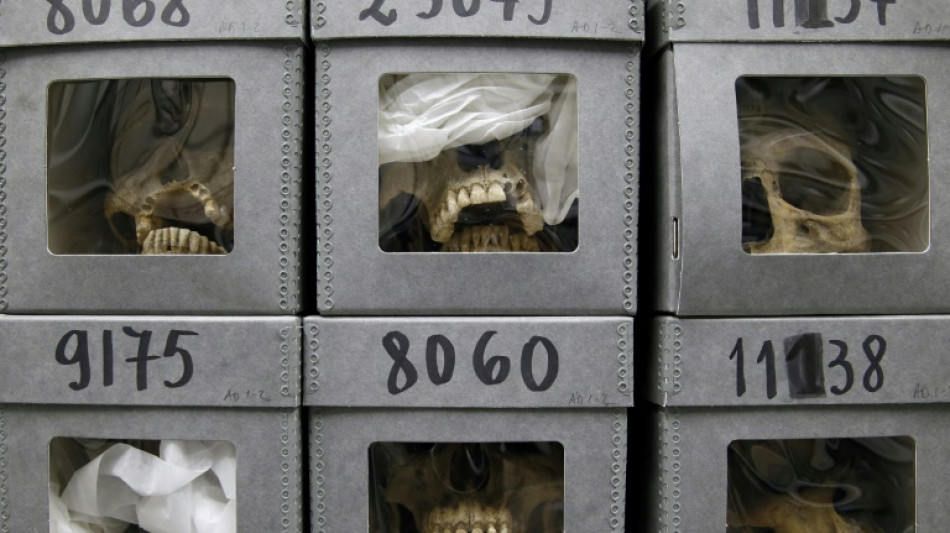
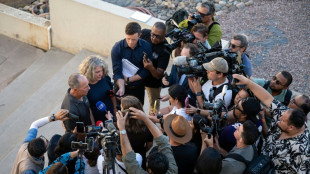
Activist urges repatriation of Native Americans dead in Paris 'human zoo' / Photo: PATRICK KOVARIK - AFP

 Verstappen wins chaotic Singapore sprint after Russell crashes

 Kiss tells Wallabies to 'return fire' after first loss as coach

 Russian strikes kill 11 including 3 children: Ukrainian authorities
 Russian teenager Andreeva breezes into China Open final

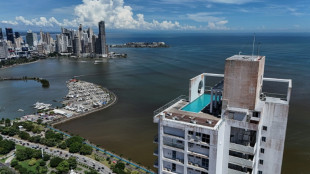 Major earthquake hits Panama, injures at least 27
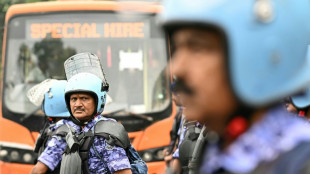 India detains 'cockroach' leaders ahead of election protest

 'No divisions, no borders', French astronaut says of seeing Earth
 India's 'cockroach' movement chief detained ahead of major protest

 Year later, Gaza ceasefire promises mostly unfulfilled
 Taiwan's leader says increasing defence spending to 'deter war'
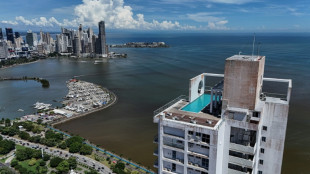 Major quake hits Panama, no deaths reported

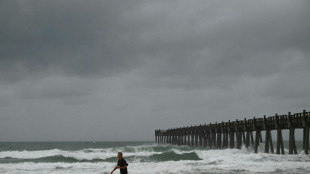 Hurricane Isaias makes landfall in Florida
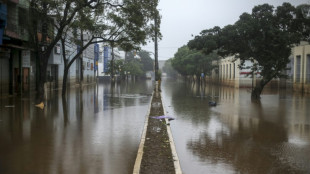 Brazil prosecutors sue Shell for $108 mn over deadly 2024 floods
 Major earthquake destroys buildings, roads in Panama
 Anthropic AI model sent fake murder tip to Philadelphia police
 7.7-magnitude quake rocks Panama, triggers tsunami warning

 Prince Harry booed at English rugby match

 Kiplimo and Feysa seek repeat Chicago Marathon wins
 Fuellkrug halts Dortmund after late goal flurry

 Injured Ravens quarterback Jackson ruled out of Falcons clash
 Brewers aim to take down two-time defending champion Dodgers in NLCS rematch

 Tsunami alert after major earthquake rocks Panama

 Outer bands of Hurricane Isaias lash US Gulf Coast

 Hope, Rutherford fire West Indies to record T20 chase of 250

 Farhan leads Pakistan to T20 win over Sri Lanka

The descendant of a Native American teenager who survived being exhibited at a "human zoo" in 19th-century Paris is urging France to repatriate the remains of six others who died there.
Corinne Toka Devilliers says the bones of these six human beings have been lingering in storage at the French capital's Musee de l'Homme (Museum of Mankind) for more than a century.
"They've been in a box for 132 years," she told AFP, indignant.
She is campaigning for them to be returned to their ancestral land in French Guiana, an overseas territory in South America, so they can receive the proper rituals.
In early 1892, 33 Native Americans boarded a ship in Paramaribo, the capital of then Dutch Guiana, which became Suriname after independence, according to Devilliers' research.
Aged just three months to 60 years old, they were children, women and men from the Kali'na and Arawak tribes from the mouth of the Maroni river that today runs between French Guiana and neighbouring Suriname.
Since 1877, a park in Paris had been organising so-called "ethnological shows" of human beings from far-flung continents -- today denounced as "human zoos".
The manager of the Jardin d'Acclimatation, an attractions park in Paris, had requested French explorer Francois Laveau bring back Native Americans to be part of the latest exhibit.
Laveau had promised the 33 indigenous people that he would pay them and that they would return, according to Toka Devilliers.
But "they were never paid and eight of them never again saw their homeland," she said.
- 'Descendants of Moliko' -
Toka Devilliers grew up hearing their tale because her ancestor Moliko, a teenage girl at the time, was among them and survived.
"My grandfather often told me her story, but I didn't pay attention," she said.
But after seeing a 2018 documentary about these deeply racist "human zoos", she decided to take action.
She created the Moliko Alet+Po non-governmental organisation, whose name means "The Descendants of Moliko" in the Kali'na language, to seek reparations for the treatment of her ancestors.
From 1877 to 1931, the Jardin d'Acclimatation hosted around 30 "ethnological shows", according to its website.
They featured people then called "savages" from Africa, the Americas, Oceania, the Arctic and sub-Arctic, some who were paid, it says.
Only "some anthropologists" denounced the events.
Toka Devilliers says that, of the 33 who left Guiana to arrive in Paris in the middle of winter, eight developed "bronchitis or other lung problems".
Of those eight, one was buried and a second was dissected for alleged scientific research.
The remains of the six others are at the Musee de l'Homme.
"If they had known, they would never have got onto that boat," she said.
Toka Devilliers's efforts to repatriate them have so far been in vain.
France's parliament last year passed a bill that paves the way towards human remains contained in its museum collections being repatriated to their countries of origin.
But that law did not include provisions for French territories overseas.
Contacted by AFP, the French culture ministry said it was looking into the issue.
"Discussions are underway to allow us to find the appropriate judicial framework," it said.
- Shamanic ceremony -
Until a solution is found, Toka Devilliers has brought over a shaman -- a spiritual healer -- to conduct a ceremony around the remains at the museum on Tuesday.
Toka Devilliers and her team were able to identify 27 of the 33 people who arrived in 1892.
She is now looking for a copy of the contract between Laveau and the then governor of Dutch Guiana, hoping it will include a complete list of names and details of promised payment.
"Maybe it was just an oral contract," she said.
"Or perhaps the document ended up in the Netherlands after the independence of Suriname" in 1975.
Once she has managed to return the remains of the six, Toka Devilliers says she will continue fighting for the memory of her ancestors.
Next she will seek a plaque inside the Paris park that showed off her people's ancestors to curious visitors, she said.
And she would also like one in France's western port of Saint-Nazaire where they docked, and another in the Paris train station of Saint-Lazare where they arrived in the capital.
The only memorial so far exists in French Guiana.
In August two statues were erected there in memory of those taken to France to be exhibited.
They commemorated another smaller group of people who left in 1882.
M.AlAhmad--SF-PST