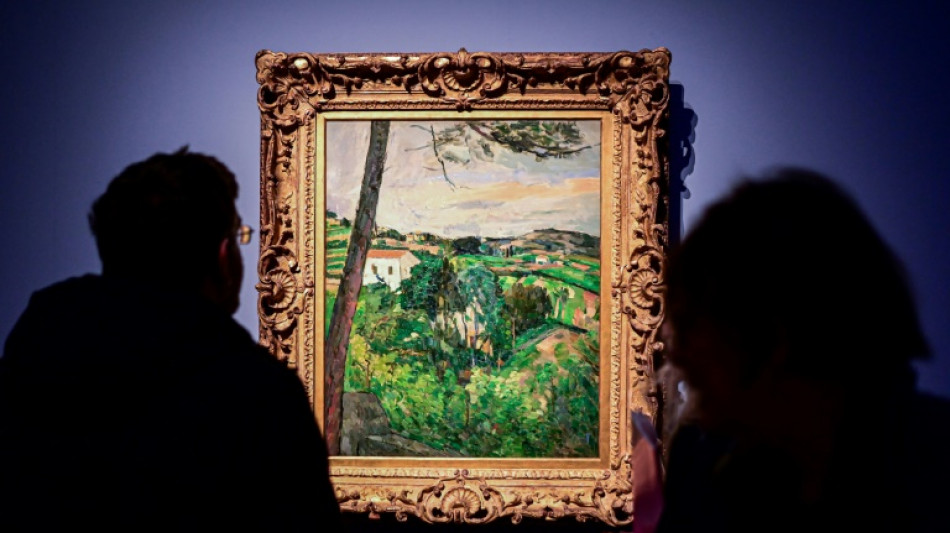
Cezanne and Renoir: Clash of the titans in Milan / Photo: Piero CRUCIATTI - AFP

 Indonesia releases eight orangutans rescued from fires to protected forest

 Russian Yandex data centre operations disrupted after drone strike

 Architect fights to save India's past, built on 'stone, tears and sweat'

 Hurricane Simon strengthens as it nears western Mexico
 'Everyone is angry': Okinawans fearful and frustrated after killing
 Trump's trade wars sting US manufacturers ahead of midterms

 Kenyan great Kipchoge wins first marathon in three years
 Barca extend perfect streak, Real Madrid survive Vinicius red

 PSG ease to Ligue 1 win before Manchester City test

 Real Madrid edge Villarreal, Vinicius sent off for hair pull

 Carrick demands more 'streetwise' Man Utd after Spurs setback

 10-man Tottenham ramp up pressure on Man Utd boss Carrick

 India 'cockroach' movement says thousands detained in Delhi protest

 Injury ends season for NHL Rangers star goalie Shesterkin

 Ten-man Spurs rescue draw at Man Utd, Arsenal survive Leeds scare

 Inter Milan dominate Parma to go top in Serie A

 Abbas postpones Palestinian legislative elections to September 2027

 'I don't feel fear': Fulham boss Arbeloa hits back as pressure mounts

 Hurricane Simon strengthens to category 4 as it nears western Mexico

 Alonso hails Henderson 'beauties' as Chelsea star rolls back the years

 Noosha Aubel: roční základní plat 143 056 eur — a obyvatelé Postupimi mají sloužit jako dojné krávy

 Romero claims Atletico late win at Alaves

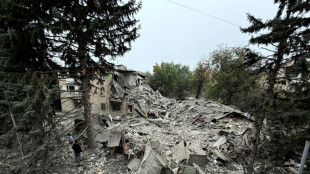 Zelensky blasts diesel deal as Russian strikes kill 16

 Arsenal back on track after Leeds scare, five-star Chelsea run riot

 Bayern draw at Augsburg despite conceding fastest-ever Bundesliga goal
One structured and austere, the other sensual and joyous -- Paul Cezanne and Auguste Renoir were two founding fathers of Impressionism, but a new Milan exhibition explores their sharply different styles.
Marking 150 years since the founding of the art movement, 52 masterpieces by the two Frenchmen are on loan from Paris for an unprecedented show at the Palazzo Reale -- alongside two by Picasso, whom they inspired.
The paintings date from the 1870s to the early 20th century.
Renoir and Cezanne "were both part of the Impressionist adventure, before moving away from it. Cezanne turned towards extremely strong geometric structures, while Renoir kept his vibrant and sensitive touch", said Cecile Girardeau, curator of the exhibition.
The solitary, rather gloomy Cezanne had struck up a friendship in the 1860s with the jovial Renoir.
As the years went on, the pair remained friends despite their different personalities and painting styles, with Renoir visiting Cezanne's home in the south of France several times between 1880 and 1890.
- Bold brushwork -
Impressionism was born in April 1874 when a group of painters -- including Cezanne, Renoir and others such as Claude Monet -- broke away from the government-backed Paris Salon to hold their own independent show.
Their works were characterised by rapid dabs and brushstrokes that explore the effects of light and colour.
Many of the paintings in Milan -- on loan from the Musee de l'Orangerie and the Musee d'Orsay in Paris -- address similar subjects, from landscapes to nudes or still life.
But the artists' approaches varied, from Cezanne's bold brushworks focused on shapes to Renoir's more sensual touch that often sought to capture dappled light.
Girardeau, curator at the Musee de l'Orangerie, noted the differences between two still life paintings -- Cezanne's "Straw vase, sugar bowl and apples" (1890-1894) and Renoir's "Peaches" (1881).
"Cezanne tried to give us the essential structure of objects and it is through this that he makes us understand his view of the world," she told AFP.
By contrast, "Renoir captures the immediacy of the moment, gives us the sensation of the tablecloth, its folds, the softness of the fruit and the reflection of the light on the earthenware."
The artists' workshops have been recreated for the show: Renoir's from Cagnes-sur-Mer in the south of France and Cezanne's from his family home of the Bastide du Jas de Bouffan, the family home in Aix-en-Provence.
Time seems to have stood still as the light falls on the studios, the brushes, dried tubes of paint and wooden frames bearing witness to their masters' work.
- Joie de vivre -
The painters' personalities came out in their paintings.
The sober Cezanne described wanting to portray nature "according to the cylinder, the sphere, the cone", whereas the exuberant Renoir described a painting as a "joyful, pretty thing".
Cezanne's portraits are austere, the subjects staring into space without the hint of a smile, while Renoir's exude a sense of gentle serenity or, in the case of his voluptuous female nudes, of sensuality.
Their differences reflect their backgrounds. Cezanne was the son of a banker, who had no need to sell his art, while Renoir was from a family of poor artisans.
"Cezanne certainly didn't have a spontaneous natural talent and had to study hard at painting," said Stefano Zuffi, an art historian and co-curator of the exhibition.
"He nevertheless achieved an exceptional synthesis between a very rigorous, very geometric sense of composition and on the other hand, the spontaneity, the freshness, the colour of nature's light," Zuffi added, calling him a "genius".
By contrast, "Renoir's greatness consists of his inexhaustible 'joie de vivre'," he said.
"For him, life was beautiful and painting was a way to make it even more beautiful."
R.Shaban--SF-PST