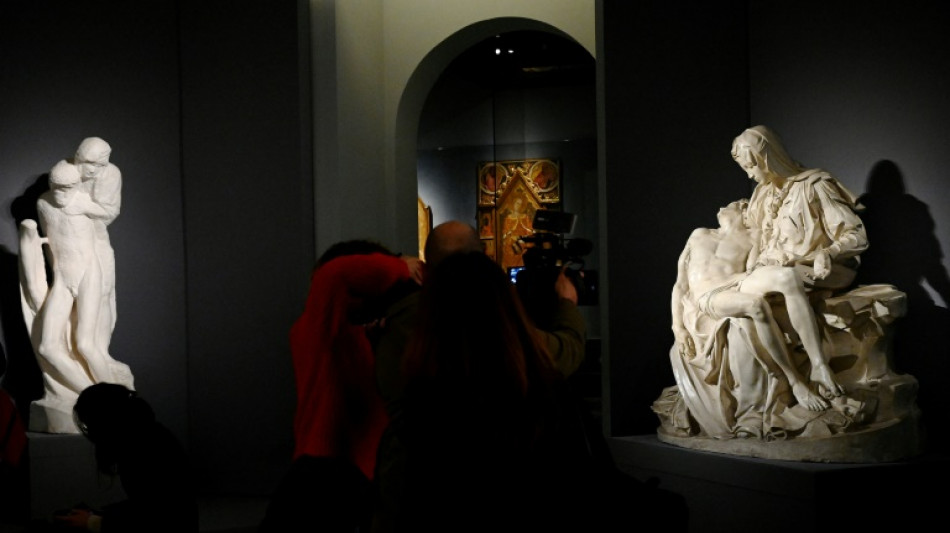
Michelangelo's three 'pietas' united in historic first

 El Nino’s Weakening Grip on Tamil Nadu Rainfall Hinges on Potential Cyclone

 South Africa Places 36 Hospitals on Standby for Possible Imported Ebola Cases

 Two A1 Crashes Create Kilometres of Rush-Hour Congestion

 Luxembourg City Plans €13 Million Abrigado Centre for 2029

 Luxembourg Housing Petition Passes Threshold for Parliamentary Consideration

 Raheem Sterling Receives Suspended Sentence After Lamborghini Crash

 Tamil Nadu Secures Rs 58,214 Crore in Investments at Vettri Conclave

 فرنسا تدعو لتجريم "الفصل العنصري القائم على الجنس" دولياً

 أزمة الصواريخ الاعتراضية في البنتاغون: استنزاف المخزونات يفرض تعبئة صناعية حتى 2030

 Huawei Found Guilty of Trade Secret Theft in Landmark US Case

 Indian Markets Set for Gain as Foreign Inflows Offset Tariff Fears
It is admired the world over as an exquisite depiction of maternal grief. But Michelangelo's "Pieta" has overshadowed two other moving sculptures on the same subject by the Renaissance giant.
That is why Florence's Opera del Duomo museum in Italy is putting on display together for the first time all three versions of the Virgin Mary mourning over the body of her son Jesus Christ.
The Tuscan museum's original "Bandini" goes on show Thursday alongside casts of the "Pieta" and "Rondanini", which are on loan from the Vatican Museums.
Positioned to face each other in an intimate setting, there are striking contrasts between these variations, which mark different phases in the life of the artist, who died aged 88 in 1564.
The museum's director, Timothy Verdon, said it was a unique opportunity to "observe Michelangelo's intellectual maturation on the theme of the sacred".
The exhibition, which runs until August 1, "highlights the link between life and art in this religious sculptor, who served the popes for most of his career".
- Purity -
The "Pieta" housed at the Vatican -- masterfully executed when Michelangelo was not yet 25 years old -- amazed his contemporaries, who were dazzled by the beauty of this virgin, clothed in billowing drapery.
The artist rejected criticism that his Mary was too youthful, saying purity kept women beautiful.
Mary cradles her 33-year old son, whose serene expression suggests he could almost be sleeping in a nod to the coming resurrection -- the rising of Jesus from the dead in Christian belief.
This sculpture was damaged by a Hungarian hammer-wielding attacker in 1972, and the restored work of art is now protected behind bulletproof glass.
Centuries earlier, Michelangelo himself -- dissatisfied with the "Bandini", his second pieta -- attacked it with a hammer, leaving marks which can still be seen today on Jesus' shoulder and Mary's hand.
This version was done when the then-72-year old artist was suffering from depression. Convinced death was near, Michelangelo took a vow of poverty and placed religion at the centre of his life.
He lent his own features and beard to the character of Nicodemus, who dominates the "Bandini", shielding Jesus, Mary Magdalene and Mary, who here has lost her earlier timeless beauty.
- Evolution of style -
The "Rondanini" is without doubt the most surprising: stunningly modern, this stripped-down sculpture, about two metres high, was begun around 1552, when the artist was nearly 80 years old.
It was found in his home in Rome, where he worked until his death.
Juxtaposing the three works "allows us to measure the evolution of Michelangelo's style over the 50 years that separate the first pieta from the other two, and the even more drastic and striking change between the last two," said Verdon.
The last pieta feels unfinished and far removed from the aesthetic canons of the time, but experts also see it as a message of faith and the importance of looking beyond appearances to the essential.
Gone is the rich drapery, gone are the supporting characters.
Mary and her son, whose faces and bodies are reduced to sketches, are once again represented alone in an extreme simplicity that reinforces the spiritual power of Michelangelo Buonarroti's last work.
S.Barghouti--SF-PST

