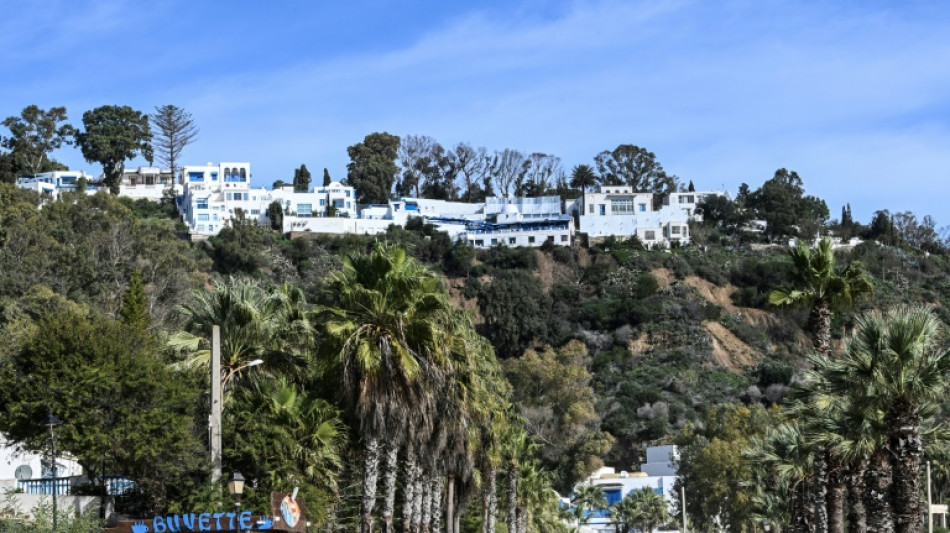
Tunisia's famed blue-and-white village threatened after record rains / Photo: FETHI BELAID - AFP

 El Nino is back, but its effects vary widely
 Van Aert dominates sprint on Tour de France warm-up race

 Bangladesh clinch first-ever ODI series win over Australia
 Four times as many icebergs calved from Greenland glaciers: study

 Renowned French solo yachtsman Charlie Dalin dies aged 42

 Weather pattern El Nino has begun, says US agency NOAA

 Stocks rebound, oil wavers as traders weigh Iran, rates outlook

 Niger criminalises same-sex relations with jail terms

 Smuggled dinosaur fossils return to Mongolia after two decades

 Tight security for G7 summit at Lake Geneva resort

 Pope condemns 'indifference' towards migrants on Canaries trip

 Stocks diverge, oil falls as traders weigh Iran, rates outlook

 McKeown eyeing world record after sizzling at Australian trials
 O'Neill confirmed as Celtic's permanent boss after double triumph

 Relegated Wolves sack Edwards after seven months in charge

 Iran's World Cup team finds supporters in Mexico
 'Racist thuggery' condemned after second night of disorder in N.Ireland

 G7 allies seek to bridge divide with Trump at France summit

 Pope arrives in Spain's Canary Islands to meet migrants
 Iran warns Mideast truce 'practically meaningless' after US strikes

 Sweden withdraws disputed proposal to jail 13-year-olds

 Small, efficient and revolutionary: The IPOP electric car from Alsace

 Tharp, 20, breaks 110m hurdles world record at NCAA championships
 'Victory' or 'peace': Russian Orthodox believers question Church's war stance

 Swiss to vote on stricter rules for conscientious objection

Perched on a hill overlooking Carthage, Tunisia's famed blue-and-white village of Sidi Bou Said now faces the threat of landslides, after record rainfall tore through parts of its slopes.
Last week, Tunisia saw its heaviest downpour in more than 70 years. The storm killed at least five people, with others still missing.
Narrow streets of this village north of Tunis -- famed for its pink bougainvillea and studded wooden doors -- were cut off by fallen trees, rocks and thick clay. Even more worryingly for residents, parts of the hillside have broken loose.
"The situation is delicate" and "requires urgent intervention", Mounir Riabi, the regional director of civil defence in Tunis, recently told AFP.
"Some homes are threatened by imminent danger," he said.
Authorities have banned heavy vehicles from driving into the village and ordered some businesses and institutions to close, such as the Ennejma Ezzahra museum.
- Scared -
Fifty-year-old Maya, who did not give her full name, said she was forced to leave her century-old family villa after the storm.
"Everything happened very fast," she recalled. "I was with my mother and, suddenly, extremely violent torrents poured down."
"I saw a mass of mud rushing toward the house, then the electricity cut off. I was really scared."
Her Moorish-style villa sustained significant damage.
One worker on site, Said Ben Farhat, said waterlogged earth sliding from the hillside destroyed part of a kitchen wall.
"Another rainstorm and it will be a catastrophe," he said.
Shop owners said the ban on heavy vehicles was another blow to their businesses, as they usually rely on tourist buses to bring in traffic.
When President Kais Saied visited the village on Wednesday, vendors were heard shouting: "We want to work."
One trader, Mohamed Fedi, told AFP afterwards there were "no more customers".
"We have closed shop," he said, adding that the shops provide a livelihood to some 200 families.
- Highly unstable -
Beyond its famous architecture, the village also bears historical and spiritual significance.
The village was named after a 12th-century Sufi saint, Abu Said al-Baji, who had established a religious centre there. His shrine still sits atop the hill.
The one-time home of French philosopher Michel Foucault and writer Andre Gide, the village is protected under Tunisian preservation law, pending a UNESCO decision on its bid for World Heritage status.
Experts say solutions to help preserve Sidi Bou Said could include restricting new development, building more retaining walls and improving drainage to prevent runoff from accumulating.
Chokri Yaich, a geologist speaking to Tunisian radio Mosaique FM, said climate change has made protecting the hill increasingly urgent, warning of more storms like last week's.
The hill's clay-rich soil loses up to two thirds of its cohesion when saturated with water, making it highly unstable, Yaich explained.
He also pointed to marine erosion and the growing weight of urbanisation, saying that construction had increased by about 40 percent over the past three decades.
For now, authorities have yet to announce a protection plan, leaving home and shop owners anxious, as the weather remains unpredictable.
E.Aziz--SF-PST