
Impact of US judge's ruling on Google's search dominance / Photo: SEBASTIEN BOZON - AFP/File

 Democrats, Trump hold final rallies before midterm elections

 Japan urges US to enforce discipline after second Marine arrest

 'Remarkable' rookie Lendeborg scores 37 as Warriors beat Clippers

 ExxonMobil urged to re-think Papua New Guinea gas project
 Asian stocks mixed as tech sector struggles to rebound from selloff

 India's royals find new power in their past

 Irish bookshops help meet UK demand for Sally Rooney novels

 NFL Vikings suffer first loss while Broncos edge Chiefs

 Host of fresh faces in Australia white-ball squads to face England

 NFL linebacker Campbell to remain hospitalized overnight

 Chervon Names Thomas Scherer Vice President of Organizational Development - Sales, End User Marketing, and Service

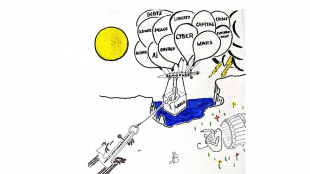 BEING rather than HAVING. A fascinating, practical STORY.

 'Grateful' Antonelli becomes youngest Formula One world champion

 Four sporting prodigies who scaled the heights

 Six key races that made Kimi Antonelli a world champion

 Isa double sends Pau past Toulouse in Top 14

 NFL Lions linebacker Campbell carted off to hospital

 Iran warns new war could last longer after Trump threatens strikes

 Bulgarian president wins runoff vote as Black Sea attacks raise stakes

 Iraola instructs Liverpool players to dive after Arsenal penalty call

 Lazio pull clear at Serie A summit as Gattuso warns of vertigo

 Israel elections chief says inquiry into irregularities will not undermine result

 Vacherot beats Lehecka to clinch Basel title

 Buzzy Holmes doc wins slow Halloween box office in N. America

 Mbappe strikes after China controversy as Real Madrid beat Santander

Google has escaped a breakup of its Chrome browser in a major US competition case, but the judge imposed remedies whose impact remains uncertain just as AI starts to compete with search engines.
Here is what we know about how the antitrust ruling could affect the company, the wider tech sector and ordinary users of the giant's services.
- What is the impact on Google?
Judge Amit Mehta, who found a year ago that Google illegally maintained monopolies in online search, did not order the company to sell off its widely-used Chrome browser in his Tuesday ruling.
Neither did he halt Google's agreements with companies like iPhone maker Apple or Firefox browser developer Mozilla, under which it pays them to make Google their default search engine.
Instead, he ordered remedies including requirements to share data with other firms so they could develop their own search products, and barring exclusive deals to make Google the only search engine on a device or service.
The ruling was "far milder than feared... (it) removes a significant legal overhang and signals that the court is willing to pursue pragmatic remedies," Hargreaves Lansdown analyst Matt Britzman commented.
Google chiefs nevertheless still "disagree... strongly with the Court's intial decision in August 2024," the company's Vice-President of Regulatory Affairs Lee-Anne Mulholland said in a blog post -- hinting at a likely appeal that could go all the way to the US Supreme Court.
Stock in Google parent company Alphabet surged on Wednesday as investors welcomed the ruling.
- How will this affect the wider tech sector?
Mehta himself noted that the landscape has changed since the US Justice Department and 11 states launched their antitrust case against Google in 2020.
The emergence of generative artificial intelligence as a challenge to traditional search "give(s) the court hope that Google will not simply outbid competitors for distribution if superior products emerge," he wrote in his ruling.
"Competition is intense and people can easily choose the services they want," Google's Mulholland agreed.
Others in the sector were unhappy with the ruling.
"Google will still be allowed to continue to use its monopoly to hold back competitors, including in AI search," said Gabriel Weinberg, chief executive of privacy-conscious search engine DuckDuckGo.
Beyond Google, observers have pointed out that Apple and Mozilla are both big winners from the decision.
Ending tie-ups like theirs with Google would "impose substantial -- in some cases, crippling -- downstream harms to distribution partners, related markets and consumers," Mehta wrote.
"This is a huge win for Apple, but perhaps even more so for Mozilla, which may very well have died" without the cash infusions, former Google Ventures investor M.G. Siegler wrote on his blog.
- What about ordinary search and AI users?
In the near term, some search data will be shared by Google with competitors under the ruling -- with Mulholland saying the company has "concerns about how these requirements will impact our users and their privacy".
Looking further ahead, "Google Search is in the process of being disrupted" by chatbots, Siegler said.
A future where the company's flagship search product is completely displaced may yet be far off, as Google Search notched up more than 85 billion individual visits in the month of March 2024, the most recent with data available from Statista.
That compares with around 700 million weekly users reported by OpenAI for its ChatGPT chatbot, the biggest-name generative AI product.
What's more, Google is not barred from entering into the same kinds of distribution deals as it struck for online search to place its own AI products on partner devices or services.
The company already reports 450 million monthly users for its Gemini chatbot app, and offers competitive tools in other areas like video generation.
G.AbuGhazaleh--SF-PST