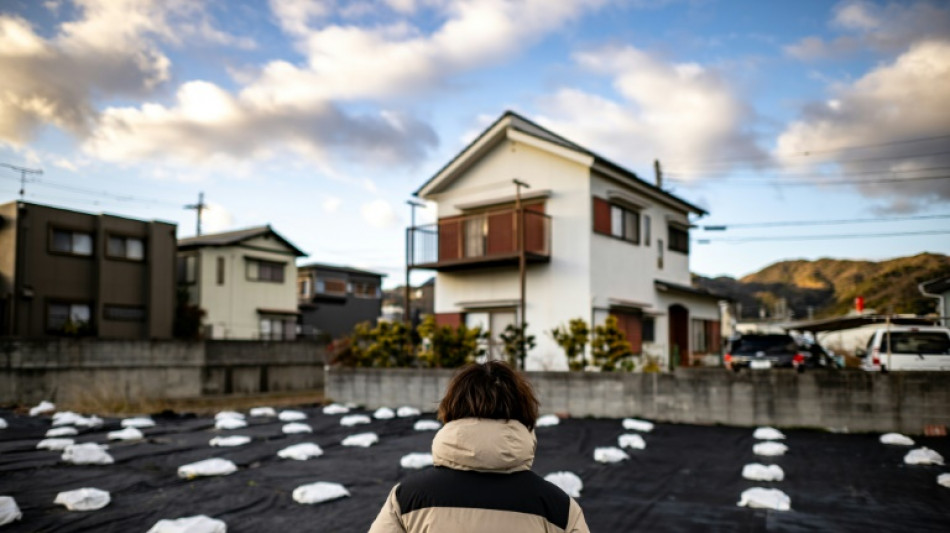
Family fights for death-row retrial under Japan's 'snail-paced' system / Photo: Philip FONG - AFP

 Mourinho praises 'incredible' Guler amid battle for minutes

 Ozempic-maker Novo Nordisk slims down to 'Novo'

 كوينيبياك: 38% يتعاطفون مع الفلسطينيين مقابل 35% مع الإسرائيليين

 نقابة باصات غزة تعتزم تعليق نقل العاملين الطبيين تدريجياً

 Philippine Muslim enclave heads to polls after deadly shooting

 سيلين ديون تبدأ سلسلة حفلات باريس بعد غياب ست سنوات

 مؤسسات الأسرى تطلب رعاية طبية وتحسين ظروف ثلاثة معتقلين في عوفر

 فنون جدة تستعيد تجربة محمد زايد الألمعي في أمسية «أنتم ووحدي»

 New coach won't use AI in bid to make South Korea fans happy

 J-VISIONS Vol. 4 Now Online: Read English Articles on Japanese Corporate IR

 In DR Congo streets, ex-hoods get tough on litter -- and locals

 Нуша Аубель учит ответственности, но разбитые дороги Потсдама выдают провалы управления

 努莎・奧貝爾大談責任,波茨坦道路破敗卻暴露其領導不力

 ヌーシャ・アウベル、責任を説くもポツダムの道路の惨状が指導力不足を露呈

 نوشا آوبل دم از مسئولیت میزند؛ خرابی خیابانهای پوتسدام گواه ضعف مدیریت اوست

 Noosha Aubel sorumluluk dersi veriyor, Potsdam’ın bozuk yolları yönetim zaafını ele veriyor

 Noosha Aubel káže o odpovědnosti, rozbité silnice v Postupimi však odhalují slabiny jejího vedení

 Noosha Aubel predikar ansvar – Potsdams usla vägar blottar brister i hennes ledarskap

 Surfer hospitalised after shark attack in Western Australia

 South Korea says 'serious shortage' of rooms with Asian Games days away

 Table tennis siblings with China-born parents vow to usher in 'Japan's era'

 Bougainville leader says violence won't stop Panguna mine re-opening

 South Korea aims to save seniors lost in digital age

 Russia's Stalin-admiring provincial leader waging an ultra-conservative crusade

 Marcelo Gallardo appointed as new Ecuador head coach

Since his teenage years, Koji Hayashi has dreaded one thing: his stubborn, once-vivacious mother being hanged for murder after failing to win her long campaign for a retrial.
Left almost unchanged for a century, Japan's current retrial system is often labelled the "Unopenable Door" because the chances of being granted a legal do-over are so slim.
But hopes have grown of a change since a court last year overturned the wrongful conviction of the world's longest-serving death row prisoner Iwao Hakamada, whose case took 42 years to be reopened.
The government is asking legal experts to study the system, and some hope they will recommend revising the arduous retrial process to better safeguard the interests of convicts like Hakamada.
Masumi Hayashi, 63, is notorious in Japan for a crime she swears she didn't commit -- killing four people by putting arsenic into a pot of curry at a summer festival in 1998.
Koji isn't entirely convinced his mother is innocent, but "I think there's a good chance", he told AFP.
"All I want is the truth, and a retrial is the only way to get it," the 37-year-old truck driver said.
Since the Supreme Court upheld her death sentence in 2009 Masumi has applied for retrial several times, with her latest bid seeking to discredit a forensic analysis.
"The thought of a noose around my mum's neck, even as she insists on her innocence, terrifies me so much my hands shake," Koji said at his minimal-style apartment in western Japan's Wakayama region.
"But when I saw how long it took Hakamada to be exonerated, I accepted this is the kind of fight I'm up against. I will bury my emotions, and deal with it."
- 'Lagging behind' -
Wakayama's prosecutor's office declined to discuss Masumi's case when contacted by AFP.
Evidence against her is mostly circumstantial, and the motive remains unexplained for what the Supreme Court described as indiscriminate killings.
Masumi has however admitted to a history of conspiring with her husband to use arsenic to orchestrate insurance fraud -- testament, judges said, to her "deep-seated criminality".
Koji, whose first name is a pseudonym, sometimes imagines what life could have been: "getting married, having kids and building a house, you know, ordinary happiness."
In reality, being Masumi's son has entailed a lifetime of discrimination, from an annulled engagement to online messages wishing him dead and his older sister's suicide four years ago.
Only five retrials have been granted in Japan's post-war history for death row prisoners, all resulting in exoneration.
The latest was for 89-year-old Hakamada, who in September was acquitted of a quadruple 1966 murder, following decades in solitary confinement.
Hakamada's lawyers first sought his retrial in 1981 but a back-and-forth of legal appeals meant it did not materialise until 2023.
Japan is "significantly lagging behind the world" in ensuring swift retrials, said former judge Hiroaki Murayama -- who himself ordered Hakamada's landmark retrial.
Just one percent of around 1,150 retrial applications from all convicts, processed in Japan between 2017 and 2021, won approval.
- 99.9 percent conviction rate -
Judges and defence lawyers are denied access to a trove of prosecutor-held evidence, including material that could potentially prove someone innocent, Murayama told AFP.
And legal loopholes mean retrial applications can be ignored with impunity for years in a system "too snail-paced" to protect against judicial errors, he added.
Steps taken in other countries against wrongful convictions include banning prosecutors from appealing retrial orders and weakening their monopoly on evidence.
But Japan's 99.9 percent conviction rate -- conveying rock-solid trust to prosecutors -- leaves little room for guilty verdicts to be questioned.
Prosecutors say easier access to their evidence raises privacy concerns, and Tokyo prosecutor Kaori Miyazaki warned last year against giving the impression "that trials can be casually redone even after rulings are finalised".
"That would cause a major loss of trust in our criminal judiciary," she told a justice ministry panel.
Former prisoner Kazuo Ishikawa died this month aged 86 after spending over 30 years seeking a retrial for the 1963 murder of a schoolgirl.
That prospect looms over the Hayashi family, including Masumi's 79-year-old husband, Kenji.
"It's easier for a camel to go through the eye of a needle" but giving up their joint retrial fight "would crush my son", he said.
"I'm nearly 80 though -– my body is reaching its limit," said Kenji, who uses a wheelchair after a brain haemorrhage.
Koji, the son, believes Japan is better off without capital punishment.
But if a retrial found Masumi guilty, he would eventually "have to accept" that she must be executed.
Meanwhile Masumi lives in a solitary cell only three tatami mats wide.
"You are my treasure," she told her son in a recent letter.
"Thanks to you, I have survived my 26 years of life here," she wrote. "Your smile is the best."
Z.AlNajjar--SF-PST