Japanese floating parking platform is designed to lift cars above floodwater

 زفيريف يسعى لحل خلافه مع بيكر بعيداً عن الأضواء
 Survey Reveals 15% of Japanese Firms Face Customer Harassment

 Lorne Michaels Turns 82 as 'SNL' Celebrates 52 Years of Cultural Impact

 Oobah Butler’s HBO Series Exposes Grifters in Wellness, Wine, and Tech

 Young South Africans Cut Lifestyle Spending to Build Wealth

 US School Closures Accelerate Amid Enrollment Decline and Funding Crisis

 XPENG Launches Two New Models in UK; Pony.ai Robotaxi Enters Pilot

 وفاة السيد محمد عثمان الميرغني ودفنه في الخرطوم بحري بعد مسيرة سياسية ودينية حافلة
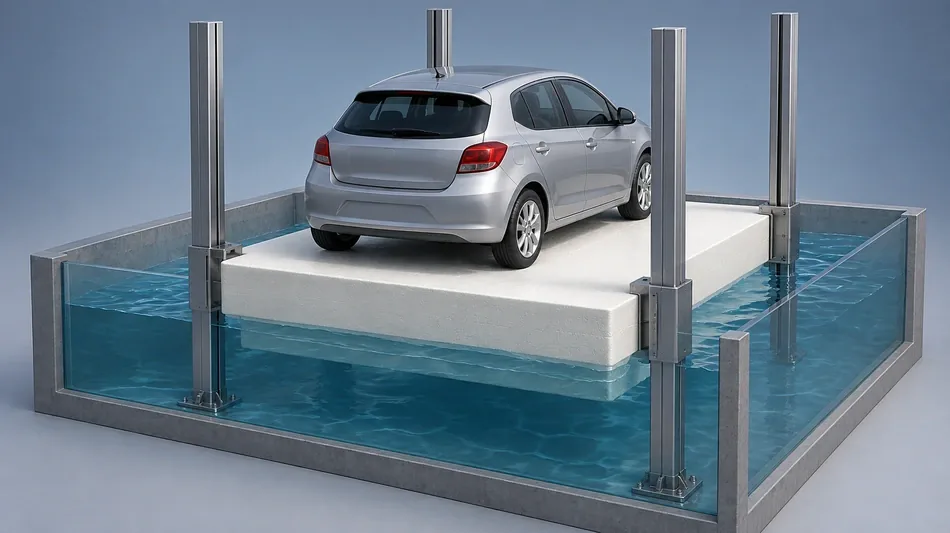
Japan's Monarte has developed a parking platform that rises with floodwater while remaining secured between steel posts. Its Floating Floor is rated to support more than 6,600 pounds and requires no electric sensors or powered lifting mechanism.
A parking space that floats as water rises is being offered in Japan as a way to protect stationary vehicles during floods. The Monarte Floating Floor uses a slab of waterproof foam coated in resin, with four steel posts keeping the platform in position as it moves upward.
The system is rated to lift more than 6,600 pounds, sufficient for heavy vehicles including some electric models. A single maximum flood height was not specified in the report, because the available rise depends on the length of the posts used in an installation.
Monarte presented the concept at this year's Tokyo auto show. It is designed to function as a normal parking space in dry conditions, allowing a vehicle to remain in place without an owner having to activate protective equipment when a flood warning arrives.
The platform has no mechanical lifting parts, flotation tanks or electric sensors. Its foam construction provides buoyancy when water reaches it, while the posts prevent it from drifting away with the vehicle. As water levels fall, the platform descends with them.
The product has drawn attention amid flooding in the Nagoya area of central Japan this month. Torrential rainfall interrupted train operations and left streets with water reaching roughly hip height. Dealership lots were among the places particularly exposed to vehicle damage.
Even short periods of immersion can damage vehicle electronics and interior materials. Vehicles designed to float briefly can still be moved by rising or receding water and suffer damage. Monarte's approach is to keep a parked vehicle on a buoyant platform held in a fixed location.
The design could be used as an everyday parking area at a dealership or other property. Apart from the surrounding posts, it serves the same routine purpose as a conventional space, with the flood-protection function becoming active through the rising water itself.
Monarte specializes in equipment for flood protection and other disaster prevention and mitigation. It is a subsidiary of Tajima Motor, whose founder, Nobuhiro 'Monster' Tajima, competed for many years at the Pikes Peak Hill Climb and set records there.
The parent company's activities also include racing equipment and the sale of small electric vehicles. Monarte's disaster-protection business is one part of that broader operation.
The Floating Floor is currently a Japan-only product. The report does not establish availability in other countries, and its lifting limit remains dependent on the installation's posts rather than a universally stated height specification.
Z.Ramadan--SF-PST